
Inventory vs Marketplace : How India’s E-Commerce giants structure around FDI Regulations
In India’s fast-evolving e-commerce landscape, competition isn’t decided solely by logistics speed, pricing strategies, or customer experience – it is fundamentally engineered at the level of corporate structure. Beneath the surface of every “Add to Cart” click lies a carefully designed legal framework that determines who can sell, how inventory can be held, and even how profits flow. At the centre of this architecture is India’s Foreign Direct Investment (FDI) policy - less a passive regulation and more a strategic force that actively shapes how digital retail businesses are built and operated.
A closer look at inventory-based and marketplace models reveals how companies navigate these rules while balancing growth ambitions, control, and regulatory compliance in one of the world’s most dynamic consumer markets.
Understanding the Legal Divide
India permits 100% FDI under the automatic route in e-commerce, but this is subject to an important caveat; such investment is permitted only for entities operating under the marketplace model. Conversely, FDI is expressly prohibited in inventory-based e-commerce models.
Inventory-based model involves the entity purchasing, owning goods and selling them directly to customers. This resembles traditional retail and is ineligible for foreign investment in B2C e-commerce.
A marketplace model, on the other hand, acts as a facilitator between buyers and sellers. The entity here, provides the platform, facilitates payments, handles logistics and earns commissions for services provided by it. However, it does not take ownership of inventory during the process.
The rationale behind this distinction is clear - allowing foreign-funded entities to control inventory and pricing could enable deep discounting at scale, potentially undermining small domestic retailers that form the backbone of India’s retail ecosystem.
Further, the framework also has certain operational safeguards in place to ensure marketplace entities do not function as disguised inventory-led businesses:
- A seller’s inventory is deemed “controlled” by the marketplace entity if more than 25% of its purchases are sourced from that entity or its group companies.
- Sellers in which the marketplace entity (or its group companies) hold an equity stake, or exercise control, are barred from selling on that platform.
- Exclusivity arrangements between marketplaces and sellers are prohibited.
The above safeguards are closely tied to how “ownership” and “control” are assessed under India’s FDI policy.
FOCC vs IOCC: The Structural Backbone
In this context, entities are often classified as Foreign-Owned and Controlled Companies (FOCCs) or Indian-Owned and Controlled Companies (IOCCs). Marketplace entities with foreign investment are typically set up as FOCCs (often through wholly owned subsidiaries in India) and are therefore restricted from owning or controlling inventory or influencing vendors.
By contrast, entities classified as IOCCs, where ownership and control vest with Indian residents, eligibility to undertake inventory-based operations is not explicitly covered in the FDI Policy.
While the FDI policy focuses on sectoral restrictions, the Master Direction introduces a broader principle that “what cannot be done directly, shall not be done indirectly”. This implies that compliance extends beyond the immediate entity to the overall structure, including parent and subsidiary relationships.
In practice, policy considerations may extend to both the parent and its wholly-owned-subsidiary if the parent is classified as a FOCC. However, certain commercial arrangements have successfully mitigated this by structuring the parent as an IOCC, thereby enabling such models. Notably, this structure has been adopted without any regulatory challenges to date, which provides comfort in its continued viability.
In light of the above regulatory framework, let’s now take a look at the structuring arrangements of some of the most popular Indian E-commerce and Q-commerce businesses and how they’ve navigated through the regulatory requirements.
- 1. Snapdeal has remained a largely pure marketplace player, ensuring full FDI eligibility. Even when it briefly adopted a “controlled marketplace” model by introducing SD+ warehouses to gain operational control over logistics and delivery, not owning inventory ensured it remained FDI-compliant.
- 2. Blinkit presents a striking example of structural transformation. Initially constrained by foreign shareholding, it operated as a marketplace. However, in 2025, its parent entity Eternal Ltd. restructured to increase domestic ownership and qualify as an IOCC. This shift allowed Blinkit to adopt an inventory-led model-enabling tighter control over pricing, margins, and supply chains.
- 3. Amazon has consistently operated as a marketplace but previously relied on affiliated sellers such as Cloudtail and Appario to exert indirect influence over inventory and pricing. Regulatory tightening in 2018–19 forced Amazon to reduce these linkages, restructure seller relationships, and recalibrate its model to remain compliant.
- 4. Flipkart demonstrates a sophisticated dual-entity structure. Its wholesale arm “Flipkart India Pvt. Ltd.” procures inventory as a B2B entity, while its marketplace arm “Flipkart Internet Pvt. Ltd.” facilitates consumer sales without owning goods. This layered model allows it to maintain indirect influence over sourcing and pricing while technically adhering to FDI rules.
As seen from the above regulatory provisions and case studies, India’s FDI framework in e-commerce does more than impose restrictions. It actively determines how firms design their business structures.
It has also made it very clear that FDI eligibility depends primarily on ownership structure and legal classification rather than the degree of operational control exercised in practice.
Strategic structuring becomes not just a compliance requirement, but a key factor in maintaining competitiveness in the e-commerce sector.

RBI Rewrites the Rules on Export Realisation – What Changes from October 1st 2026
On January 13, 2026, the Reserve Bank of India notified the Foreign Exchange Management (Export and Import of Goods and Services) Regulations, 2026, coming into force October 1, 2026. The new framework also folds in imports for the first time, but this piece looks only at the export side – the provisions that change how Indian exporters declare, realise, and repatriate their earnings.
So what did the earlier regime look like?
The FEMA (Export of Goods & Services) Regulations, 2015 were built around fixed numbers.
- Exporters had 9 months from shipment to realise proceeds, extendable in blocks of 6 months subject to conditions.
- Export advances had to be routed through a single Authorised Dealer (AD) bank.
- Set-off of export receivables against import payables was allowed only bilaterally – same overseas counterparty, same calendar year, never goods against services.
- Third-party receipts needed a tripartite agreement and a declaration on the shipping bill itself.
So why did RBI feel the need for a rewrite?
Two threads run through this.
The first is consolidation – the 2015 framework had scattered across the principal regulation, Master Directions, and a trail of circulars. The 2026 Regulations mainly intends to fold all of this into one principle-based instrument.
The second, more interesting thread is a shift in who decides. Under the earlier regime, even routine matters – a reduction in export value, or the refund of an unrealised advance – required RBI's sign-off. This resulted in the AD bank, sitting closest to the actual trade relationship, having little room to apply commercial judgment. That created real friction for businesses, and equally left AD banks under-utilised as a first line of oversight.
What's actually changing for exporters now
- Declaration: A unified Export Declaration Form (EDF) now covers goods, software and non-software services too. Under the 2015 rules, non-software service exporters had no prescribed declaration to file at all, leaving these exports untracked until proceeds came in. That gap closes now with EDI-port filings for goods are deemed submitted automatically, and service exporters must furnish an EDF within 30 days from month-end of invoicing.
- Realisation of proceeds: Proceeds must come in within 15 months of shipment or invoice, stretched to 18 months for INR-invoiced/settled exports – a marked easing from the 2015 flat 9 months. Proceeds unrealised beyond a year from the due date trigger a consequence where further exports to that buyer must be against full advance or an irrevocable LC. The EDF/EDPMS mechanism ensures that every export gets logged at the time of shipment, and the entry stays open until the AD confirms realisation, which automatically flags non-receipt for follow-up.
- Reduction/write-off in export receivables: This is no longer an RBI-threshold matter – it's an AD call on reasoned request. For shipping bills or invoices up to Rs. 10 lakh, a customer declaration alone suffices. For bills or invoices above Rs. 10 lakh, the AD takes a call once satisfied that the exporter's cited reasons are genuine. In practice, this meaningfully cuts paperwork for low-value shipments and immensely benefits small exporters. It also speeds up what used to be a genuinely slow approval chain – exporters dealing with a genuine buyer dispute, a quality claim, or a partial short-shipment can now get a write-off resolved directly with their bank instead of waiting on a separate RBI reference.
- Set-off: Permitted within the overseas buyer's group or associate companies, not just the identical counterparty, and across goods and services as long as it's done within the export realisation period. This is a genuine widening from the old bilateral-only test. For businesses with intra-group trade – one entity exporting to an overseas affiliate while another imports from a related company in the same chain – this allows genuine netting instead of two separate settlements, easing forex conversion costs and working capital strain.
- Third-party receipts: For a third-party paying on behalf of the customer, the requirement of a tripartite agreement between the exporter, third-party and customer no longer exists. The AD simply needs to be satisfied the arrangement is genuine. This is particularly useful for exporters who sell through distributors, agents, or receive payment via factoring and international collection arrangements. Payments will no longer get held up for want of upfront paperwork naming every party in the chain.
- Advance receipts: The current amendment removes prescribed timelines specifying how long the exporter could hold advance receipts. The AD bank now has the discretion to decide based on reasonability. Refund of advance in case of a shipment that didn’t materialise no longer requires RBI approval. Exporters can also shift the advance and later realisation to a different AD, as long as both banks are informed.
Taken together, these changes point to one clear theme – the AD bank's role has expanded dramatically. Extensions, write-offs, set-offs, third-party receipts, advance refunds: decisions that once needed RBI's sign-off now rest entirely with the exporter's bank. But that expanded role comes with expanded responsibility. Each AD must now publish its own documented SOP under Regulation 19, covering documentation, delegation, and charges – which means exporters can no longer assume uniform treatment across banks and need to actually engage with their own bank's policy.
In effect, the 2026 Regulations haven't removed oversight – they've relocated it, from RBI's desk to the AD bank's, and the framework's real test will be how consistently individual banks exercise that judgment.

Handling Contingent Liabilities and Litigation Exposure in Business Valuations
Every set of financial statements has a section most readers skip: the notes on contingent liabilities. A tax demand under appeal. A supplier dispute in arbitration. A guarantee given for a group company. None of these appear on the balance sheet, because accounting standards do not require them to be recognised until an outflow becomes probable. But a buyer acquiring the business inherits every one of them. For a valuer, that gap between what is recognised and what is real is exactly where the work lies.
1. Why These Items Matter to Value
A contingent liability is an obligation that may arise depending on the outcome of a future event outside the company's control. Because it is not recognised in the books, it does not reduce reported net worth. But it can reduce economic value significantly.
2. What Typically Shows Up
The exposures that most commonly require attention in Indian valuations fall into a few recognisable categories.
Direct and indirect tax disputes are the most frequent. Income tax demands under appeal before the Commissioner, Tribunal, or higher courts, and GST or legacy excise and service tax matters, appear in the contingent liability note of a large proportion of Indian companies.
Beyond tax, there are commercial disputes with customers, suppliers, or distributors, often in arbitration. Employment and labour matters, including disputes over termination, gratuity, or provident fund contributions. Corporate guarantees issued on behalf of group companies or associates. Claims relating to property title, land acquisition, or environmental compliance. And in regulated sectors, penalty proceedings initiated by the relevant regulator.
Each carries a different probability profile and a different potential quantum, and they cannot sensibly be treated as a single line item.
3. Assessing the Exposure
The valuer's task is not to predict legal outcomes. It is to arrive at a reasoned economic estimate of the expected cost.
For each material matter, three things need to be established. First, the maximum potential exposure, including interest and penalty where applicable. Second, an assessment of likelihood, which is best supported by written opinion from the company's legal or tax advisors rather than management's own view. Third, the expected timing of resolution, since a matter likely to conclude in seven years has a very different present value than one expected to settle next year.
4. Reflecting It in the Valuation
There are two broadly accepted ways to bring these exposures into the valuation, and consistency matters more than the choice between them.
The first approach treats the expected cost as a debt-like item in the bridge from enterprise value to equity value. The business is valued on its operating cash flows, and the probability-weighted litigation exposure is then deducted alongside borrowings and other non-operating liabilities. This is the more common approach and keeps the operating and non-operating analysis cleanly separated.
The second approach incorporates the expected cash outflows directly into the projected cash flows in the year they are anticipated. This works well where the timing is reasonably certain and the amounts are recurring in nature.
5. Accounting Interface
The accounting treatment and the valuation treatment answer different questions, and the distinction is worth keeping clear.
Accounting standards require a provision to be recognised only when an outflow is probable and the amount can be reliably estimated.
Valuation applies no such threshold. A matter assessed at a thirty percent likelihood of adverse outcome creates no accounting provision, but it does create expected economic cost, and a rational buyer will price it. This is why the contingent liability note is a starting point for the valuer rather than a conclusion.
6. Conclusion
Contingent liabilities occupy an awkward space in valuation. They are real enough to affect what a buyer will pay, but uncertain enough that no single number can be called correct. The response is not to ignore them, which understates risk, nor to deduct them in full, which overstates it. It is to assess each material exposure on its own facts, apply a reasoned probability, and disclose the working.
For unlisted Indian companies, where tax litigation in particular tends to accumulate over years, this analysis often makes the difference between a valuation that holds up in negotiation and one that unravels during diligence.

India's M&A Reset: Sectors, Structures and the Tax Lens
India's deal market has entered a phase of fewer but larger transactions. M&A value in the first half of 2026 rose roughly 31% to about USD 86.9 billion even as volumes eased around 8%, with the second quarter alone contributing USD 66.9 billion — the strongest quarter since 2022. Healthcare, industrials and financial services led. What is changing, though, is not merely quantum but architecture. Acquirers are choosing their vehicle and their instrument deliberately, for tax efficiency, regulatory speed and control, rather than defaulting to a plain share purchase.
Real estate: platforms, not properties
Dealmaking has shifted from asset trades to platform consolidation. The second quarter of 2026 saw 39 transactions worth USD 2.3 billion, with M&A volumes at a record 22 deals. L&T Realty's USD 121 million acquisition of a 20-acre land parcel and the combined USD 323 million investment by Mindspace Business Parks REIT and 360 ONE Alternates into Radial IT Park illustrate the two poles — land aggregation at one end, income-yielding platforms at the other. Structures are dominated by SPV-level share acquisitions, with each project ring-fenced in its own company or LLP; business transfer agreements for slump sales of divisions; and, increasingly, REITs, SM-REITs and Category II AIFs. Insolvency continues to supply inventory, as in the Amtek Group's resolution-plan acquisition of the Supertech ORB project.
Healthcare: fragmentation meets capital
Sun Pharma's roughly USD 11.75 billion all-cash purchase of Organon and Torrent Pharma's acquisition of JB Chemicals from KKR anchor a sector whose underlying logic is the consolidation of a highly fragmented hospital and single-specialty market. Structures range from straightforward share purchase agreements with locked-box pricing, through NCLT-sanctioned schemes of arrangement for intra-group hospital mergers, to doctor-partner arrangements housed in LLPs or management services companies to work within state clinical establishment rules.
IT and AI: buying capability, not revenue
IT services recorded 449 transactions worth about USD 14.8 billion in the first half of 2026, led by Coforge's USD 2.35 billion all-stock acquisition of Encora. AI has developed its own grammar. Buyers are paying for models, data and teams rather than earnings — Krutrim's purchase of BharatSahAIyak is the domestic marker. Globally, non-exclusive technology licensing coupled with a team hire, the so-called reverse acqui-hire, has emerged as a way to secure talent without triggering merger review. Indian variants lean on milestone-based earn-outs, extended ESOP vesting and retention bonuses, since non-competes have limited enforceability here. Asset purchases of intellectual property and datasets, rather than acquisitions of the entity, are increasingly common.
Manufacturing: scale, supply chains and succession
Tata Motors' EUR 3.8 billion takeover of Iveco Group signals outbound ambition; domestically, manufacturing accounts for roughly a tenth of deal volume, driven by production-linked incentive capacity, component localisation and promoter succession. Slump sales of undertakings and demergers of non-core divisions dominate, frequently as a precursor to a third-party sale.
Holding structures and instruments
The Indian holding company remains the workhorse, with SPVs beneath it for project- or plant-level ring-fencing and clean exit. Foreign investors continue to route through Singapore and the Netherlands, though GIFT City IFSC vehicles are steadily drawing structures back onshore.
On instruments, compulsorily convertible preference shares remain the default for private equity, allowing liquidation preference, anti-dilution and downside protection without immediate dilution; compulsorily convertible debentures offer a fixed coupon with equity conversion; optionally convertible instruments and non-convertible debentures appear where exchange control permits. The distinction matters: under FEMA, only fully and compulsorily convertible instruments count as equity. Optionally convertible instruments are treated as external commercial borrowings, with the pricing, maturity and end-use constraints that follow.
Tax and regulatory implications
Structure drives outcome. A share sale attracts capital gains - currently 12.5% on long-term gains from unlisted shares - and the buyer inherits the target's entire history. A slump sale is taxed with net worth as cost, the gain being long-term where the undertaking was held for more than 36 months, and it leaves liabilities behind.
Court-approved amalgamations and demergers that meet the statutory conditions remain tax-neutral for the company and its shareholders and permit carry-forward of losses, subject to continuity tests. Itemised asset sales attract GST, and immovable property attracts stamp duty at state rates - often the deciding variable in a real estate transaction.
On the regulatory side: CCI clearance where asset, turnover or deal-value thresholds are crossed; government approval under Press Note 3 for investment from land-bordering countries; the exchange control prohibition on foreign investment into entities engaged purely in real estate business, against 100% automatic-route access for construction development; SEBI's takeover code for listed targets.

Retrenchment under the new labour codes? Here’s what employers need to know
Employers often assume that terminating employment for business reasons is simply a contractual matter resolved by paying notice pay. However, where such termination falls within the scope of “retrenchment” under the Industrial Relations Code, 2020 (“Code”), additional statutory requirements apply.
When does Retrenchment Apply?
Under the Code, an employer-initiated separation may be a “lay-off” or a “retrenchment”. A lay-off is a temporary inability to provide work while the employment relationship continues and the employee remains on the muster rolls.
Retrenchment, however, is permanent termination of employment for reasons other than those specifically excluded under the Code. Termination for business reasons may therefore constitute “retrenchment” under section 2(zh).
Who is Covered?
Retrenchment provisions may apply to employees who:
- have completed at least 1 year of service; and
- qualify as “workers” under the Code.
“Workers” broadly include persons engaged in manual, unskilled, skilled, technical, operational, clerical or supervisory work.
Employees mainly in managerial or administrative capacities are excluded, as are supervisory employees drawing wages exceeding ₹18,000 per month.
Employers should therefore assess each case based on the employment agreement, job description and actual functions performed.
What is the Retrenchment Process?
Where the retrenchment provisions apply, employers should consider the following:
- Last Come, First Go Principle: Under Section 72, the employer must retrench the last person employed in the relevant category, unless reasons for deviation are recorded in writing.
- Notice Period: One month’s written notice, or wages in lieu, is required; a longer contractual notice period prevails.
- Retrenchment Compensation: Eligible workers who have completed at least one year of continuous service are entitled to retrenchment compensation, in addition to notice pay.
How is Retrenchment Compensation Calculated?
Under section 70, compensation equals 15 days’ average pay for every completed year of continuous service, or part thereof exceeding 6 months.
Retrenchment Compensation = Last Drawn Wage × Years of Service × 15/26
*For this purpose, Wages = Basic + DA + Retaining Allowance.
What Happens if the Company Wishes to Hire Again?
Section 73 requires an employer proposing to hire within 1 year of retrenchment to first offer the retrenched worker an opportunity for re-employment, with preference over other candidates.
Conclusion:
Retrenchment for business reasons is not merely a contractual exercise. Where the Code applies, employers must also comply with statutory requirements on selection, notice, compensation and re-employment.
- Determine whether the employee qualifies as a “worker” and has completed the required service period.
- Record reasons for any deviation from the “last come, first go” principle.
- Notice pay and retrenchment compensation are separate entitlements.
- Retrenched workers shall have preference where similar hiring occurs within 1 year.
- All statutory and contractual dues should be identified and settled.

Nominee: A trustee or legatee
A nominee is a person designated by an account holder, insured, or shareholder to receive financial assets or policy proceeds upon the death of such account holder, insured, or shareholder. respectively. It is a common misconception among the general public that, upon nomination, the nominee becomes entitled to own and enjoy the property or asset for their own benefit, i.e., as a legatee. In this article, we demystify the conception that a nominee is a legatee rather than a trustee.
Understanding the concept of Nomination:
From a layman's perspective, a nominee is the person who receives the benefits of an investment after the death of the account holder. This has led to a popular belief that a nominee enjoys complete ownership over the nominated asset.
Legally, however, a nominee is only viewed as a trustee - a person who receives the asset and holds it for the benefit of those legally entitled to it - rather than a legatee, who is the actual beneficiary or inheritor. Let’s take a look at each law, its treatment of nominations and judicial precedents around them.
Insurance Act, 1938
Section 39 of the Insurance Act, 1938 permits policyholders to nominate a person to receive policy proceeds. Traditionally, courts have treated nominees as mere recipients of the money.
In Sarbati Devi v. Usha Devi (1984), the Supreme Court held that the nominee acts as an authorized recipient and the insurance proceeds form part of the deceased's estate, to be distributed according to applicable succession laws.
Banking Regulation Act, 1949
Section 45ZA of the Banking Regulation Act, 1949 allows a bank to release the deposit amount to the nominee after the depositor's death. The provision primarily protects the bank by ensuring a valid discharge of its liability.
In Ramdas Shivram Sattur v. Rameshchandra Shah (2009), the Bombay High Court held that a nominee receives the amount for administrative convenience of the Bank only. This release by Bank to the nominee does not extinguish or exclude the claims of legal heirs.
Company Shares: The debate
Section 72 of the Companies Act, 2013 provides that, upon a shareholder’s death, nominated securities vest exclusively in the nominee, overriding other testamentary claims unless the nomination is changed. In the Harsha Nitin Kokate v. The Saraswat Co-operative Bank Limited (2010), the Bombay High Court held the nominee as the legal and beneficial owner, thereby allowing the nomination effectively overriding succession. This ruling was owing to the language in section 109A of the Companies Act, 1956 (similar to present section 72 of Companies Act, 2013) on “right to vest” and the overriding effect of the non-obstante clause.
The Kokate Judgment was overruled by another Bombay High Court judgment, Jayanand Jayant Salgaonkar v. Jayshree Jayant Salgaonkar (2015), wherein the Kokate judgment was held per incuriam. The Court held that the legal heirs, and not nominees, would have ownership over the shares. The Court considered the provisions of Section 109A of the Companies Act, 1956 and held that they do not displace the law of succession.
The debate as to whether a nominee is trustee or legatee was conclusively settled recently by the Supreme Court in Shakti Yezdani & Anr. v. Jayanand Jayant Salgaonkar (2023). It was held that a nominee even under the Companies Act, 2013 is merely a trustee and not a legatee on five grounds:
- There was no legislative intent in Companies Act to confer ownership on nominees by creating a third form of succession.
- The purpose of Companies Act is to regulate corporate affairs and not inheritance rights.
- Interpreting a nominee as a trustee would ensure consistency with the interpretation adopted under other statutes.
- The overriding effect of the non-obstante clause operates primarily to protect the company by providing a valid discharging of its liability.
- The term “vest” is context-dependent and does not ipso facto confer beneficial ownership on the nominee.
Conclusion:
The law on nomination in India is now largely settled across various statutes. While nomination facilitates the smooth transfer of funds or securities upon the death of the holder, it does not ordinarily confer beneficial ownership on the nominee. The Apex Court’s decision in Shakti Yezdani has reaffirmed this principle even in the context of company shares, clarifying that nomination does not create a separate mode of inheritance or override succession rights. Accordingly, a nominee’s role is primarily administrative in nature, ensuring an efficient discharge of obligations by insurers, banks, and companies. The ultimate ownership of the asset continues to be governed by testamentary dispositions or succession laws.
- A nominee is not automatically the owner of the nominated asset.
- Nomination primarily enables institutions to transfer assets and discharge liability efficiently.
- Legal heirs can still claim rights over assets received by a nominee.
- Proper estate planning and a valid will remain more important than nomination for determining ultimate ownership.

Normalising Financials Before Valuation: Related Party Transactions, Promoter Remuneration, and One-Offs
Before you value a business, you have to decide what its earnings actually are. In an Indian unlisted company, reported profit rarely reflects true economics. Promoter salaries may be set for tax reasons. Rent may be paid to a family trust at a rate no third party would accept. A one-time land sale may have inflated last year's profit. Normalisation strips all of this out to arrive at earnings a buyer would actually pay for.
1. Why Normalisation Matters
Multiples and discounted cash flow models both rest on one foundation: sustainable earnings. Distort that base and everything built on it is distorted too, by a multiple.
Take a company reporting profit before tax of two crore rupees. If promoter remuneration is one crore above market, normalised profit is closer to three crore. At eight times, that single adjustment moves enterprise value by eight crore. The methodology did not change. Only the input did.
2. Related Party Transactions
These are the most common source of distortion in closely held companies. Not improper in themselves, but frequently priced on considerations other than market value. Watch for:
- Rent paid on promoter-owned property above or below market rates
- Management fees charged by a group holding company
- Interest-free or concessional loans between group entities
- Purchases from a supplier owned by a family member
- Salaries paid to relatives who may not be actively involved
For each material item, establish what an arm's length price would have been and adjust accordingly. Transfer pricing documentation and independent market data on rentals and service fees are useful reference points. The related party disclosure note is a starting point, not a conclusion. Some arrangements never make it into the disclosure at all.
3. Promoter Remuneration
Almost always the largest single adjustment in an owner-managed business. Promoters often draw well above or below what a professional would command, usually reflecting a preference for salary over dividend, or reinvestment back into the business.
The adjustment replaces actual remuneration with the market cost of hiring someone to do the same job. That requires an honest look at what the promoter actually does. A founder who generates the revenue, holds the client relationships, and drives product cannot be replaced cheaply. A promoter whose role is oversight can be.
This distinction matters twice over. Heavy promoter dependence is itself a valuation risk that may warrant a discount, separate from the remuneration adjustment.
4. One-Off and Non-Recurring Items
Items that hit reported profit in a period but are not expected to repeat:
- Income side: gains on sale of assets or investments, insurance claims, write-back of old liabilities, unusual foreign exchange gains, discontinued government incentives
- Expense side: litigation settlements, restructuring costs, one-time bad debt provisions, losses from discontinued operations, aborted transaction expenses
The judgement is whether an item is genuinely non-recurring. A business writing off large bad debts every alternate year does not have one-off events. It has a receivables problem, and normalising it away overstates sustainable earnings.
5. Accounting Considerations
Normalisation is for valuation purposes only. It does not alter the financial statements or represent a restatement.
That said, check that accounting policies are applied consistently across the period analysed. Changes in depreciation method, revenue recognition timing, or inventory valuation can create apparent profitability trends that have nothing to do with performance.
6. Key Considerations in Practice
- Cover three to five years, not a single year. Patterns only emerge over time
- Document each adjustment individually with its basis and quantum. These are the entries most likely to be challenged
- Apply adjustments consistently across all years. Normalising remuneration in the current year alone creates an artificial growth trend
- Check peer comparability. If normalised earnings are compared against peer multiples, consider whether peer earnings were similarly adjusted
- Present the summary transparently. A reader who disagrees with an adjustment should be able to see exactly what was done and why
7. Conclusion
Normalisation is where valuation stops being mechanical and starts requiring judgement. Two valuers working from identical financials can reach different normalised earnings, and both may be defensible. What separates credible work from weak work is not the absence of judgement but the transparency and consistency with which it is applied.
Sustainable earnings, not reported earnings, are the foundation of any credible valuation. Related party pricing, promoter remuneration, and non-recurring items are where the two most often diverge in Indian unlisted companies. Identify each adjustment, quantify it, document it, and apply it consistently. The exercise takes time and invites disagreement, but a valuation built on unadjusted book profits is unlikely to survive scrutiny from a buyer, an auditor, or a regulator.

Private Equity's New Playbook: Roll-Up Acquisitions and Value Creation — An India Tax and Regulatory Perspective
India's private equity landscape is undergoing a structural shift. With over 1,40,000 DPIIT-registered startups and compressed valuations across sectors, PE firms are increasingly turning to roll-up acquisitions - serial, consolidation-driven buyouts of fragmented businesses -to build scale, capture market share, and engineer outsized exits. For investors and corporate strategists, understanding the interplay between deal structure, tax efficiency, and regulatory compliance is the difference between value creation and value erosion.
A. The Buy-and-Build Imperative
- The classic buy-and-build strategy involves acquiring a platform company, then bolt-on acquiring smaller competitors to create a dominant, scaled entity. In India, this playbook is gaining traction in sectors like D2C, SaaS, edtech, healthtech, and logistics.
- PE sponsors typically execute roll-ups through a dedicated holding company or special purpose vehicle (SPV). This structure offers critical advantages: liability ring-fencing across acquired subsidiaries, consolidated tax planning, and a cleaner exit pathway – whether through an IPO, strategic sale, or secondary transaction.
- The arithmetic is compelling. Acquirers can buy individual startups at 2x–4x revenue multiples and, post-consolidation, position the combined entity for 8x–12x multiples, creating a valuation arbitrage that underpins the entire strategy.
B. Structuring the Deal: Tax Efficiency at the Core
- Share Purchase is the fastest route—typically 4–8 weeks—but triggers capital gains tax for selling founders. For unlisted shares held over 24 months, long-term capital gains (LTCG) are taxed at 12.5% without indexation from FY 2024–25 onward. Short-term gains (held under 24 months) are taxed at the seller's slab rate, up to 30% plus surcharge and cess. The acquirer inherits all assets, liabilities, and regulatory approvals, making due diligence critical.
- Asset/Slump Sale allows cherry-picking of assets while avoiding legacy liabilities. Under Section 50B of the Income Tax Act, capital gains are computed on the difference between sale consideration and net book value. Crucially, if structured as a transfer of a "going concern," the transaction is exempt from GST under Notification 12/2017. However, selective asset sales attract GST at 18% on intangibles and goodwill, and stamp duty ranges from 3% to 10% depending on the state.
- NCLT Merger under Sections 230–232 of the Companies Act, 2013 is the most tax-efficient but compliance-intensive route, taking 6–12 months. Share-for-share exchanges are exempt from capital gains under Section 47(vi) and (vii) of the Income Tax Act, deferring tax liability until the eventual sale of new shares. Additionally, Section 72A allows the surviving entity to carry forward the losses of the amalgamating company—a powerful value-creation tool. Stamp duty is typically reduced or exempted, as the transfer occurs by operation of law rather than voluntary conveyance.
The Finance Bill, 2026 introduces further refinements. Buyback taxation has reverted to a capital gains regime for shareholders (net of cost of acquisition), replacing the previous dividend-characterization approach. While this benefits most shareholders through preferential capital gains rates, it imposes an additional income tax levy on "promoters" - now defined to include any person holding over 10% of shares in an unlisted company. This expanded definition captures significant minority shareholders and must be factored into exit planning.
Perhaps more consequential for leveraged roll-ups is the proposed disallowance of interest deductions against dividend income. Under the new regime, interest expenditure incurred to earn passive investment income (including dividends from subsidiaries) will be fully disallowed from 1 April 2026. This directly impacts traditional leveraged buyout (LBO) structures, where acquisition debt is often serviced through dividend distributions from target entities. PE sponsors must re-evaluate leverage models, as the restriction increases effective tax costs and may necessitate alternative financing structures.
C. Regulatory Navigation: The CCI, FEMA, and NCLT Maze
India's regulatory framework for roll-ups is multi-layered and unforgiving of procedural lapses.
- Competition Commission of India (CCI) notification is mandatory when combined assets cross monetary thresholds. The regime is mandatory and suspensory – transactions cannot close, even partially, without prior approval.
- FEMA Compliance is non-negotiable for cross-border elements. Foreign investors must adhere to FEMA (Non-Debt Instruments) Rules, 2019, RBI reporting through FC-GPR/FC-TRS forms, and sectoral FDI caps. DCF-based pricing guidelines for unlisted companies require robust valuation documentation, and restricted sectors (defence, telecom, media) demand prior RBI approval.
- Post-Acquisition Compliance is where many roll-ups falter. ROC filings (Form INC-28, MGT-14, SH-4, DIR-12) must be completed within 30 days. Sector-specific licenses—FSSAI, drug licenses, import-export codes—do not automatically transfer even in NCLT mergers and require fresh applications.
D. Exit Opportunities and the Risks of Excessive Consolidation
The ultimate test of a roll-up is the exit. India's capital markets are maturing, with IPO windows opening for consolidated entities that can demonstrate scale and profitability. Strategic acquirers - both domestic conglomerates and global players - pay premiums for market leaders. Secondary sales to other PE funds are increasingly liquid.
However, the risks of excessive consolidation are real and growing. The CCI's enhanced digital forensics capabilities and dawn-raid powers mean that anti-competitive conduct - price coordination, market allocation, or information sharing between acquired entities - faces unprecedented scrutiny.
From a tax perspective, GAAR provisions under Income Tax Act cast a long shadow over aggressive structuring. The Supreme Court's recent ruling in Tiger Global International reinforced that treaty benefits are not automatic where arrangements lack commercial substance. PE sponsors must ensure that holding company structures, especially those leveraging DTAA jurisdictions like Singapore or Mauritius, can withstand substance tests.
E. Conclusion
Roll-up acquisitions represent one of the most compelling value-creation strategies in India's current PE environment. The opportunity to consolidate fragmented industries, apply operational discipline, and exit at scaled multiples is genuine. But the Indian regulatory and tax framework demands precision. The choice between share purchase, slump sale, and NCLT merger determines tax outcomes measured in crores. CCI compliance is mandatory and enforced. The new interest-deduction restrictions and expanded promoter-tax definitions from Finance Bill, 2026 require fresh structural thinking.
For investors and strategists, success lies not in replicating Western playbooks, but in mastering India's specific compliance architecture - building deal structures that are tax-efficient, regulatorily defensible, and operationally executable. In India's fragmented markets, the firms that get this right will define the next decade of private equity value creation.

Selling Property in India as an NRI: A Practical FEMA Guide
For the many Indians living abroad, a flat in Mumbai or a plot in Bengaluru is often both an investment and a link to home. Sooner or later, many decide to sell and that is when the Foreign Exchange Management Act, 1999, universally called FEMA, steps in. FEMA is the law that governs how money and assets move between India and the rest of the world. It sets the rules for what a Non-Resident Indian (NRI) can sell, to whom, and how much of the money can be taken abroad.
The good news is that FEMA is largely permissive: it allows NRIs to own and sell property in India. But the fine print matters, and three questions decide almost everything. What kind of property it is, how it was originally acquired, and who is buying it.
What you can sell, and to whom
For most people, the property in question is a house, flat, or commercial unit. Here FEMA provides: an NRI can freely sell residential or commercial property to a resident Indian, to another NRI, or to an Overseas Citizen of India (OCI).
The picture changes sharply for agricultural land, plantation property, and farmhouses. An NRI cannot buy these at all; they can only end up owning such property if they acquired it while still living in India (i.e., while they were Resident Indian) or inherited it. And when it comes time to sell, this kind of property can be sold only to a resident Indian and not to another NRI or OCI.
Taking the money abroad: the real question
Owning and selling is usually straightforward. The part that trips people up is repatriation, moving the sale proceeds out of India. Here, how you originally acquired the property is decisive.
If you bought the property after becoming an NRI, using foreign money remitted through banking channels or funds from your NRE or FCNR account, the proceeds are generally repatriable subject to conditions and to paying applicable taxes first. For residential property, repatriation is allowed for up to two properties.
If instead the property was bought while you were still a resident of India, or inherited from someone in India, it falls under a special provision (Section 6(5) of FEMA). Proceeds from these cannot be freely sent abroad. The money is credited to your Indian rupee account and taking it out requires working within the annual remittance limit (currently around USD 1 million per financial year), after tax compliance.
Which bank account matters
NRIs typically hold three types of accounts, and the sale proceeds must land in the right one:
- NRO (Non-Resident Ordinary): the default destination especially for inherited or gifted property, or where proceeds are not immediately eligible to go abroad. Money can still be remitted out later, within the annual limit and after taxes.
- NRE (Non-Resident External): fully repatriable, but proceeds can be credited here only when they genuinely qualify for repatriation under FEMA essentially, when the property was bought with eligible foreign funds.
- Foreign bank account: receiving the sale money directly abroad, bypassing Indian banking channels, is not advisable. FEMA expects the transaction to flow through an authorised Indian bank.
Before selling, an NRI should trace the history of the property: when and how it was bought, what funds were used, and whether any inheritance is involved. That history determines whether the money can travel abroad freely or must wait in a rupee account. A clean paper trail, remittance records, purchase documents, tax filings make the eventual repatriation far smoother.
FEMA, in short, is less a barrier than a set of gates. Residential and commercial property enjoy wide freedom; agricultural and plantation land stays firmly within India; and the route your money takes abroad depends on how it entered the property in the first place.

Impairment Testing under Ind AS 36: Key Considerations
Every acquisition comes with a story about synergies, market share, and the value that two businesses will create together. Goodwill is that story, sitting on the balance sheet as a number. But that also needs to be revisited. When reality falls short of expectation, goodwill must be tested, and if the numbers no longer support it, impairment comes into play.
What Is Goodwill and Why Test It?
When a company acquires another, it usually pays more than what the books say the target is worth. The excess is goodwill, which is the premium paid for brand, customer relationships, market position, and expected synergies.
Unlike most assets, goodwill is never depreciated. It sits on the balance sheet until there is reason to question whether it still holds value. If the test concludes that the acquired business is no longer worth what was paid for it, goodwill must be written down. This charge hits the income statement immediately, reduces reported profits, and cannot be reversed.
How the Test Works
Impairment testing follows three steps.
First, goodwill is allocated to a Cash Generating Unit (CGU), which is the smallest group of assets that generates independent cash inflows, typically a business segment or an acquired entity. Getting this allocation right matters, because the test is only as meaningful as the unit it is applied to.
Second, the recoverable amount of the CGU is determined. This is the higher of what the business would fetch in an open market sale after disposal costs, or its Value in Use, being the present value of future cash flows the business is expected to generate. For unlisted companies, where market-based evidence is limited, Value in Use computed through a discounted cash flow model is the more commonly used measure.
Third, if the carrying amount of the CGU, including allocated goodwill, exceeds its recoverable amount, an impairment loss is recognised. The write-down is absorbed first by goodwill, and only after goodwill is exhausted, spread across the other assets.
Triggers for Testing
Goodwill must be tested at least annually. But Ind AS 36 also requires testing whenever indicators suggest that value may have eroded. Waiting for the annual cycle in such situations is not acceptable.
Some of common triggers include consistent underperformance against the original acquisition business case, loss of key customers or talent, and decisions to restructure or exit parts of the acquired business.
Accounting and Financial Impact
An impairment charge reduces the carrying value of goodwill permanently and is recognised in the income statement in the period it arises. Under Indian tax law, this charge is generally not tax-deductible, which gives rise to a difference between accounting profit and taxable income. This difference is required to be recognised and disclosed in the financial statements.
The reduction in goodwill also correspondingly reduces total assets and net worth as reported in the balance sheet. Financial statement notes are required to disclose the circumstances that led to the impairment, the CGU to which goodwill was allocated, the amount of the impairment charge, and the key assumptions underlying the recoverable amount calculation, including the discount rate and the long-term growth rate applied.
Where Companies Go Wrong
Over-optimistic cash flow projections are the most common shortcoming. Management teams naturally believe in the acquisitions they championed, and that belief tends to colour the projections used in the impairment model. Projections that show a sharp recovery without grounding in historical trends or industry benchmarks are difficult to substantiate under auditor review.
Discount rate errors are also common. The standard requires a pre-tax rate, but many companies use a post-tax cost of capital without the required adjustment, or apply the group-wide rate to a CGU that carries a very different risk profile.
CGU aggregation is another area of concern. Grouping a weaker business with a stronger one into a single CGU can make the combined unit appear healthy, delaying recognition of impairment in the underperformer.
A related issue is the mechanical roll-forward of prior year assumptions: same discount rate, same growth rate, no fresh review. Economic conditions, industry dynamics, and company-specific factors evolve, and the assumptions in the impairment model must reflect that.
Conclusion
Goodwill impairment testing is a question of whether the carrying value on the balance sheet continues to reflect what the acquisition is genuinely worth. For unlisted companies, where this assessment rests almost entirely on internal estimates, the rigour applied to projections, discount rates, and CGU identification determines the credibility of the outcome.
Three things separate credible impairment testing from a routine compliance exercise: projections grounded in evidence rather than aspiration, a discount rate calibrated to the specific CGU's risk profile rather than a group average, and consistent monitoring for impairment indicators throughout the year. Impairment losses, when they eventually surface, are rarely the result of technical errors. More often, they reflect assumptions that were not revisited often enough or challenged with sufficient rigour by management, auditors, and boards.

Indirect Transfer Provisions under the Income-tax Act: Impact on Global M&A, Judicial Precedents, and the DTAA Dimension
A. Statutory framework
Indirect transfer taxation in India seeks to tax gains arising to a non-resident from the transfer of shares of a foreign company, where those shares derive their value substantially from assets situated in India. The provision rests on Section 9(1)(i) of the Income-tax Act, 1961, which deems income accruing through the transfer of a capital asset situated in India to be taxable in India.
The doctrine acquired its present shape after the landmark Vodafone litigation. When Vodafone acquired Hutchison's Indian telecom interests in 2007 by purchasing shares of CGP Investments, a Cayman Islands company, the tax authorities sought to tax the offshore deal. In Vodafone International Holdings BV v. Union of India (2012), the Supreme Court held that the transaction was a bona fide offshore share transfer outside Indian taxing jurisdiction, since the subject of transfer was a foreign company's shares and the look-through approach could not be read into the statute.
In response, the Finance Act, 2012 introduced Explanations 4 and 5 to Section 9(1)(i) with retrospective effect from 1 April 1962, clarifying that shares of a foreign company would be deemed situated in India if they derived their value substantially from Indian assets. The Finance Act, 2015 then supplied much-needed thresholds: under Explanations 6 and 7, value is "substantial" only if Indian assets exceed INR 10 crore and represent at least 50% of the company's global asset value, while a small-shareholder exemption protects transferors holding less than 5% of capital or voting power with no management rights. Valuation and reporting mechanics were prescribed through Rules 11UB–11UC and Form 49D.
B. Impact on global M&A and group structures
These provisions reshaped cross-border deal structuring. Acquisitions of multinational groups with Indian subsidiaries, internal reorganisations, private-equity exits routed through holding companies in Mauritius, Singapore or the Netherlands, and even intra-group transfers now require an India tax assessment. Buyers insist on withholding-tax indemnities, valuation certificates and tax representations. Group restructurings that move Indian-derived value between offshore entities can trigger Indian capital gains even where neither party is Indian-resident, and the obligation to withhold tax under Section 195 falls on the non-resident payer. The compliance and documentation burden, particularly the apportionment of gains attributable to Indian assets, has materially raised transaction costs and lengthened diligence timelines.
C. Judicial and arbitral precedents
The retrospective amendment provoked sustained litigation. In the Vodafone investment arbitration (2020), the Permanent Court of Arbitration at The Hague held that India's retrospective levy breached the fair-and-equitable-treatment guarantee of the India–Netherlands bilateral investment treaty. Around the same time, in the Cairn Energy arbitration (2020), the tribunal ruled India's retrospective demand violated the India–UK investment treaty and awarded Cairn roughly USD 1.2 billion plus interest and costs — an award Cairn began enforcing against Indian state assets abroad.
On the domestic front, the Andhra Pradesh High Court in Sanofi Pasteur Holding SA v. Department of Revenue (2013) addressed the transfer of shares of a French company (ShanH) that indirectly held Shantha Biotechnics in India. The Court held that, under the India–France treaty, the resulting capital gains were taxable only in France, allowing the treaty to prevail over the retrospective domestic amendment. However, it is important to note the Supreme Court ruling in the case of Tiger Global wherein it was held that The Court held that indirect transfers of Indian assets structured through intermediate jurisdictions to avoid taxes can be taxed under the General Anti-Avoidance Rules (GAAR).
The political resolution came through the Taxation Laws (Amendment) Act, 2021, which nullified the retrospective effect. It provided that no tax demand would survive for indirect transfers made before 28 May 2012. This effectively closed the Vodafone and Cairn disputes and restored a measure of investor confidence.
D. The DTAA dimension
Where a tax treaty applies, Section 90(2) allows the taxpayer to invoke the treaty if more beneficial than domestic law. Capital gains are governed by Article 13 of most treaties. Crucially, gains from the alienation of shares of a foreign company often fall within the residuary clause (commonly Article 13(5) or 13(6)), which assigns taxing rights exclusively to the state of residence of the alienator. In such cases, the indirect transfer provisions of domestic law can be neutralised by the treaty, as Sanofi case provides.
However, with the Apex Court ruling emphasizing on substance over form and application of anti-abuse rules such as GAAR / principal-purpose test, the scope of Treaty benefits appears to be narrow.
Indirect transfer provisions remain a defining feature of India's cross-border tax landscape. While the 2021 reform removed the retrospective sting, prospective transactions deriving substantial value from Indian assets continue to demand careful structuring, robust valuation, and a close reading of the applicable treaty.

Karnataka minimum wage notification: Impact on business and employees
On 22nd May 2026, the Government of Karnataka rolled out a notification under the Minimum Wages Act, 1948 updating the monetary thresholds for wages. In this notification, the threshold for minimum wages was increased, the list of ‘Scheduled Employments’ (explained below) was updated and calculation of variable dearness allowance for FY 2025-26 was provided. In this article we highlight the changes made, its impact on the wage structure and way forward for employers.
A. Legal Validity and Implementation:
An obvious question that arises is how a notification be issued under a repealed statue (for the uninitiated, the Minimum Wages Act, 1948 is repealed and subsumed under the Code on Wages, 2019) and how such notification would be legally valid. To put it succinctly, the notification is legal and valid, as it is saved by section 69(2) of the Code on Wages, 2019 (“Code”). Section 69(2) of the Code deems any notification/order made under the Minimum Wages Act, 1948 to have been made under the Code as long as it does not contradict any provisions of the Code.
With respect to implementation, the notification does not provide a specific effective date. In such situations, it can be considered that as and when it is notified in the official gazette it is effective and enforceable. From a compliance standpoint, employers are expected to give effect to the revised minimum wage thresholds at the earliest, i.e., in the next payroll cycle following such publication.
B. Changes brought by the Notification:
The impugned notification introduced four changes, namely:
- Workers employed in cleaning toilets, bath houses, drainage systems, and those employed in power generation units, foundries (with or without the use of machines), manufacturing of insecticides, pesticides and chemical fertilizers are prescribed different schedules for minimum wages.
- New employment categories have been added into the Scheduled Employment (viz., those employments to whom the Minimum Wages Act, 1948 applies). To illustrate - Teachers at Private Schools and Colleges, E-commerce and Courier Services, Religious and Charitable Institutions, Public Amusement Parks, Water theme parks, Manufacturing of products related to coconuts and its husk and many more.
- A uniform minimum wage limit has been prescribed for all the scheduled employments (except those mentioned under point 1 above), and the thresholds have also been uniformly increased. The minimum wage limit for the scheduled employment stands as thus:
- The Variable Dearness Allowance shall be fixed for a period starting from 01st April to 31st March of the next year. The VDA for the FY 2025-26 is set at Rs. 1030.80 per month and at Rs. 39.64 per day.
| Skill Category |
Zone-1 Region under Greater Bengaluru Authority |
Zone-2 Regions under the limits of other Municipal corporations of the State |
Zone-3 Regions not covered under Zone 1 or Zone 2 |
|||
|---|---|---|---|---|---|---|
| Per Day | Monthly | Per Day | Monthly | Per Day | Monthly | |
| Highly Skilled | 1196.69 | 31114.02 | 1087.90 | 28285.47 | 989.00 | 25714.07 |
| Skilled | 1087.90 | 28285.47 | 989.00 | 25714.07 | 899.09 | 23376.43 |
| Semi-Skilled | 989.00 | 25714.07 | 899.09 | 23376.43 | 817.35 | 21251.30 |
| Unskilled | 899.09 | 23376.43 | 817.35 | 21251.30 | 743.05 | 19319.36 |
C. Incorporation of this threshold into Payroll:
The term “wage” as defined under section 2(y) of the Code includes Basic, Dearness Allowance (“DA”) and Retaining Allowance (“RA”) (if any). Every other element of a payroll other than Basic, DA or RA, such as contribution to pension and insurance scheme, overtime wage, bonus, house rental allowance, commission, gratuity, retrenchment compensation etc. would not be wage but part of the gross salary. To represent it, gross salary = ‘Wage’ + other components.
Section 5 of the code reads that “No employer shall pay to any employee wage less than the minimum rate of wage notified by the appropriate government”. This definition, when read along with the definition of Wage and the impugned notification, makes it clear that that wage component of the gross salary should at the very least meet the thresholds prescribed under the notification.
Now while incorporating this, it is important to add the DA component to the basic component of the wage. To illustrate:
- Consider an employee who is highly skilled and working in Bangalore, then his/her minimum wage would be
Basic          + DA             = Minimum Wage
31104.02  + 1030.80    = 32,134.82
- Now consider an employee who is semi-skilled and working in Mysore (under the Mysore Municipal Authority), then his/her minimum wage would be:
Basic          + DA             = Minimum Wage
23376.43  + 1030.80    = 24,407.23
Conclusion:
The Karnataka Minimum Wage notification dated 22nd May 2026 by increasing the monetary thresholds, aims to ensure fair compensation and aligns it with the current economic conditions. For Employees, the revised thresholds provide for enhanced financial entitlement and increase the take home. However, for Employers, it is time to review and recalibrate the payroll structure to ensure that firstly, the wage component of the gross salary meets the minimum wage threshold prescribed based on their skill level and zone applicable to the employee in the said notification. Secondly, on recalibrating the wage component, the employees must ensure that the contribution to employee provident fund and pension schemes are also recalculated. Lastly, it should also ensure that in the total gross salary, the components other than wage must not be more than 50% of the gross salary.
- For all Scheduled Employments, the minimum wages must be calculated on the definition of wage under the Code on Wages, 2019.
- The wage component of the gross salary shall not be less than the monetary thresholds prescribed under the notification.
- Employers must recalibrate payroll of every employee based on their skill level and zone they are employed at and ensure that the wage component and other components of the gross salary as per applicable law.

Revisiting LBC Investments: India’s Evolving FDI Approach
Ever since liberalisation in 1991, India has continued to be one of the most sought-after destinations for foreign investment, primarily driven by its large market, favourable governance and regulatory framework, and strong growth potential.
Within this, the regime governing Foreign Direct Investment (FDI) has largely remained liberal, with investments in most sectors permitted under the automatic route, subject to the provisions of the Foreign Exchange Management Act, 1999 and the FEMA (Non-Debt Instruments) Rules, 2019.
However, in 2020 in the backdrop of COVID-19 and resulting economic uncertainty, the Indian government took a bold stand to curb opportunistic acquisitions of Indian companies during the pandemic and safeguard national interest.
Press Note 3 issued by the Department for Promotion of Industry and Internal Trade (DPIIT) on 17th April 2020, introduced restrictions on FDI from entities located in, or whose beneficial owners are situated in, countries sharing a land border with India. Such investments which were earlier permitted under the Automatic route, if the sector was otherwise open to FDI, were now allowed only under the Government approval route.
The press note outlined three specific triggers requiring government approval:
- The investor was an entity incorporated in a land-border country; or
- The beneficial owner was situated in a land-border country; or
- The beneficial owner was a citizen of a land-border country.
Further, the press note clarified that these restrictions would also apply to any transfer of ownership of existing or future FDI that results in beneficial ownership falling within the scope of the above-mentioned countries
While the move was an apt way considering the prevailing geo-political scenario then, it gave rise to many challenges in practice.
A key issue was the absence of a clear threshold or test to determine “beneficial ownership” which led to varied interpretations. Some investors relied on definitions under other laws, while others adopted conservative approaches, treating even minimal Land Bordering Countries (LBC) linked ownership as sufficient to trigger approval. As a result, a significantly higher number of transactions were routed through the Government approval process. This created procedural bottlenecks and delays, slowing investment inflows from LBC jurisdictions.
The impact was particularly high for global private equity and venture capital funds operating through layered structures. Even a small, non-controlling participation by an LBC-linked partner could bring an entire investment under the approval route, regardless of the absence of any governance or control rights. Consequently, investors with merely financial exposure were also captured within the regime.
Similarly, multinational corporations with incidental or minority LBC ownership faced compliance burdens disproportionate to the actual risk. Routine transactions such as downstream investments, restructuring exercises and secondary transfers required detailed scrutiny for indirect LBC exposure, increasing transaction costs and timelines.
Another significant challenge arose from the use of the phrase “situated in”, which extended the trigger beyond citizenship to include residency. This had unintended consequences, particularly in the context of employee stock option plans (ESOPs). ESOP issuances to employees residing in LBC jurisdictions even if they were not citizens required Government approval. This created challenges for multinational companies and complicated cross-border workforce mobility and compensation structures.
These challenges highlighted the need for a more well-thought-out framework that balanced national security concerns with ease of doing business. Press Note 2 (2026), issued on 15 March 2026, was a landmark step taken in that direction. Subsequently, the notification amending the Foreign Exchange Management (Non-debt Instruments) Rules, 2019 was released on 1 May 2026, providing the legal backing and operational clarity to the policy shift.
The term “beneficial owner” is now aligned with Section 2(1)(fa) of the Prevention of Money Laundering Act, 2002, which defines it as an individual who ultimately owns or controls a client of a reporting entity, or the person on whose behalf a transaction is conducted, including anyone exercising ultimate effective control over a juridical person.
Press Note 2 (2026) and the corresponding amendments to the Foreign Exchange Management (Non-debt Instruments) Rules, 2019 specify that the term “beneficial owner” shall be determined as per the criteria laid down in sub-rule (3) of Rule 9 of the Prevention of Money-laundering (Maintenance of Records) Rules, 2005. Under this framework, the identification of beneficial owners follows a structured approach:
- Companies: Natural persons holding more than 10% ownership or exercising control (e.g., appointing majority directors, influencing policy decisions).
- Partnership firms: Natural persons entitled to more than 10% of capital or profits, or exercising control over management/policy.
- Unincorporated associations/bodies of individuals: Natural persons with more than 15% ownership or entitlement.
- Trusts: Identification of the author, trustee, beneficiaries with ≥10% interest, and any person exercising ultimate effective control.
- Fallback: Where no natural person is identifiable, the senior managing official is deemed the beneficial owner.
- Listed entities: For companies listed on Indian stock exchanges (or notified foreign exchanges) and their subsidiaries, beneficial owner identification is not required.
The revised framework clarifies that LBC-linked beneficial ownership will be triggered only where such persons or entities
- exceed prescribed 10% threshold limit (15% for associations), or
- have the ability to exercise control, or
- can exercise ultimate effective control
This three-limb test marks a shift from a broad, ownership-agnostic test to a more nuanced, control-based approach.
Further, Press Note 2 removes the phrase “situated in”, narrowing the scope of application to just a citizenship-based criteria. This change has a direct impact on ESOP structures since approval is now required only where the recipient is a citizen of an LBC. Employees merely residing in such jurisdictions without citizenship are no longer covered, significantly easing compliance for multinational employers.
The broader reform which also includes a SOP issued by DPIIT on 4th May 2026 introduces a fast-track approval mechanism for LBC investments in specified sectors, with an indicative 60-day decision timeline.
However, it is to be noted that these relaxations apply to LBCs except Pakistan. The regulations for Pakistan continue to remain the same where no citizen of Pakistan or an entity incorporated in Pakistan shall invest only under the Government route, in sectors or activities other than defence, space, atomic energy and such other sectors or activities prohibited for foreign investment;
On a comparative note, while Press Note 3 adopted a broad and restrictive approach, recent reforms reflect a more calibrated framework, introducing objective thresholds and a control-based test to distinguish between strategic and purely financial investments. By refining the scope of restrictions and introducing proportionate safeguards, the policy strikes a better balance while still reinforcing India’s attractiveness as a stable and predictable investment jurisdiction.
- India’s FDI environment prior to 2020 was largely open and facilitative, allowing most foreign investments to come in without prior government scrutiny.
- The 2020 restrictions introduced a protective filter for investments linked to land-bordering countries, reflecting heightened concerns around economic vulnerability and national interest.
- Over time, the wide scope of the 2020 rules created practical difficulties, as even indirect or low-risk LBC connections could slow down otherwise routine business transactions.
- The 2026 amendment brings the regime closer to a substance-over-form approach by focusing on meaningful ownership, influence and control rather than mere technical links.
- For businesses, the revised framework is expected to reduce unnecessary approval burdens and support smoother fund raising, restructuring, ESOP and cross-border investment activity.

Famous, reputed or well-known? Untying the knots in trademark law
Do you think if a trademark is considered to be well-known, it is a reputed mark as well? There is nothing wrong in assuming the terms to be synonymous if you do not belong to the legal fraternity. But in the legal parlance, there is a very delicate line of difference between the two phrases. In other words, we could say that “every famous brand is reputed, but not every reputed mark is legally ‘well-known’.” In this article, we will break down the use of these phrases and put them in proper perspective for the benefit of the non-lawyers.
Let us consider a scenario where your mom is looking for a groom for you, and she says she has registered your profile in the ‘Gucci matrimony.’ On hearing, you are astonished and instantly think, when did Gucci start their matrimony services. Even though Gucci has nothing to do with the local matrimony site, the mark is so universally recognized that even the common man can relate the service with Gucci in less than a second. This is what the law addresses as a “well-known mark.”
Meanwhile your father brings you sizzling hot onion pakoras from one of the best tea shops in town called the ‘Iyengar Delight’ which serves hot tea and snacks. Everyone in the city recognizes it, but only a very few from outside the city will know it. This shows that the brand has extreme reputation and strong goodwill only within that locality. This differentiates a “well-known mark” from a “mark with reputation.”
Where does the law actually stand?
The trademark law posits certain grounds under Section 11(6) of the Trade Marks Act, 1999 (“Act”), for a mark to be considered as a “well-known mark”, viz.,
- the acknowledgment the mark has gained amongst the ‘relevant sector of the public’;
- the proof of duration for which the mark is “well-known” and the geographical area where the mark is of use or being promoted or advertised;
- the proof of when and where it is registered or any application has been filed for registration under the Act; and,
- the record of successful enforcement rights by which the trademark has been recognized as a well-known mark by any court or registrar.
On the other hand, Section 29 of the Act speaks about infringement and Section 29(4)(c) stipulates the conditions for a ‘mark with reputation’, that is, the registered trademark has a reputation in India, and the use of the mark without due cause takes unfair advantage of the reputation of the registered trademark. Thus, a mark with reputation is nothing but a criterion to satisfy infringement and does not possess any other additional privileges
In conclusion, a “well-known mark” is where the holder of the mark can initiate a suit for infringement and has an additional privilege of preventing registration of the trademark under any class of goods or services, but a ‘mark with reputation’ is something which is only a prerequisite for infringement.
The Delhi High Court tried to clarify this confusion in Bloomberg Finance Lp V. Prafull Saklecha & Ors., CS (OS) No.2963 of 2012 by establishing that if a trademark is legally recognised as well-known, this status fills the ‘reputation rule’ under Section 29. Likewise, in RPG Enterprises Ltd v. Riju Ghoshal.,2022 SCC OnLine Bom 626, the Court laid down that the words ‘well-known mark’ and ‘mark with reputation’ cannot be used interchangeably as they fulfil two different purposes under the Act. Yet another point to be taken note of is the local reputation criterion. If the intent of Section 29 is looked at, the mark requires reputation in India, but no such condition can be found in Section 11.
- A reputed trademark is a mark that has goodwill and recognition among a particular set of population or local reputation, while a well- known mark enjoys broader public recognition, may be even transborder reputation.
- Every well-known mark is reputed, but not every reputed mark is legally recognised as “well-known.”
- Well known trademarks get a special privilege of preventing others from using it for unrelated goods and services because the consumers will be able to relate it to the original brand.
- The phrases cannot be used interchangeably as each of it has its own purpose reiterating the intent of law.

Down Rounds in Indian Startups: Valuation Reset and Investor Dilution
Every startup story celebrates the up-round — a higher valuation, more investor confidence, headlines. But what happens when the next round comes in lower than the last? That is called as a down round. And in India's startup ecosystem, they are no longer rare events.
1. What Is a Down Round?
A down round occurs when a company raises fresh capital at a valuation lower than its previous funding round. In simple terms, the company is now valued less on paper than it was before.
This can happen for several reasons such as weaker than expected business performance, a shift in market sentiment, tighter investor scrutiny on unit economics, or regulatory risks. In India, the funding benchmarks of 2022-23 triggered several high-profile down rounds, bringing valuations that had surged during the 2021 boom period sharply back to earth.
2. How Valuation Is Reset in a Down Round
The new valuation in a down round is typically negotiated commercially between the company and incoming investors, based on current business fundamentals - revenue, burn rate, growth trajectory, and comparable market transactions.
Valuation methodologies used include:
- Income Approach (DCF) - revised with more conservative growth assumptions and higher discount rates reflecting increased risk
- Market Approach - recalibrated against current trading multiples of comparable companies, which may have contracted significantly
- Recent Transaction Approach - benchmarked against similar funding rounds in similar-stage companies
The reset valuation determines the price per share at which new investors come in — and this lower price is the trigger for anti-dilution protection mechanisms for existing investors.
3. Investor Dilution — Who Bears the Pain?
Dilution in a down round is not felt equally. Its impact depends on the type of shares held and other terms in the shareholders agreement.
Founders typically bear the most dilution. They hold common equity with no downside protection. A lower valuation combined with a larger share issuance to new investors and potential conversion adjustments for existing investors can significantly erode their ownership percentage.
Early-stage investors without anti-dilution protection face the same fate as founders, their percentage stake shrinks without any compensatory adjustment.
Investors with anti-dilution protection are partially shielded. The practical effect of anti-dilution clauses is that the dilution burden shifts — away from protected investors and onto founders, early stage investors and employees holding ESOPs.
4. Key Considerations Before and During a Down Round
Companies navigating a down round should address the following before closing the transaction:
- Review all existing investor agreements for anti-dilution clauses, consent rights, and pre-emptive rights — these may require formal waivers before new shares can be issued
- Obtain a fresh independent valuation to support the new price - this is essential for regulatory compliance and for defending the pricing to existing shareholders
- Assess accounting reclassification risk - review whether any convertible instruments or preference shares need to be reclassified following the reset
- Communicate proactively with ESOP holders - a down round resets FMV and affects the value of unvested and vested options; timely communication avoids disputes
- Board and shareholder approvals - fresh issuance of shares requires board approval and, in most cases, a special resolution from shareholders under the Companies Act
5. Conclusion
Down rounds are a structural feature of startup ecosystems — not an anomaly. In India, where valuations ran ahead of fundamentals through much of 2020-21, corrections were inevitable. The companies that navigate down rounds well are those that plan for them with robust shareholder agreements, clean cap table documentation, independent valuations, and transparent communication. A down round need not define a company's trajectory. But how it is managed almost always does.
A down round is as much a governance event as it is a financial one. The valuation reset is just the headline, beneath it lies a chain of legal, accounting, tax, and stakeholder obligations that demand careful execution. For founders, the lesson is to negotiate anti-dilution terms thoughtfully at every round, not just when things look uncertain. For investors, it is a reminder that paper markups are not returns. And for the ecosystem at large, down rounds are a necessary correction mechanism that, when handled well, restore credibility and set the stage for sustainable growth.

Family business preservation
Tax, Structuring & Regulatory Perspectives
Family-owned businesses account for a dominant share of India's private sector output and employment. Yet transferring family wealth and business control across generations remains fraught with legal complexity, tax exposure, and regulatory risk. A structured approach — addressing entity design, tax planning, and compliance architecture — is essential for business continuity and wealth preservation. These challenges are not unique to India; family enterprises globally navigate similar tensions between control, tax efficiency, and governance.
1. Family Business Structure Mechanisms — Indian & Global Perspective
The table below maps the key structuring vehicles available to family businesses, drawing from both Indian law and global practice, along with the core tax and regulatory considerations for each:
| Structure | Indian Context | Global Equivalent | Tax & Regulatory Highligh |
|---|---|---|---|
| Private Limited Company / Corporation | Pvt. Ltd. under Companies Act 2013; DVRs & Article-based transfer restrictions keep ownership within family | S-Corp / C-Corp (USA); GmbH (Germany); SAS (France); Pte Ltd (Singapore) | Dividend Distribution Tax removed (w.e.f. FY21); LTCG on unlisted shares at 12.5% without indexation; Companies Act governs buybacks & RPTs |
| Hindu Undivided Family (HUF) | Unique to India; treated as separate taxable entity under IT Act 1961; own exemption slab & deductions | No direct global equivalent; loosely analogous to Family Partnership in civil law countries | Income taxed at individual slab rates; HUF partition tax-neutral u/s 171 IT Act; Clubbing provisions apply on transfers to spouse / minor children |
| Discretionary / Specific Trust | Indian Trusts Act 1882; assets outside personal estate of settlor; protection from creditors & matrimonial claims | Revocable / Irrevocable Trusts (USA, UK); Jersey / Cayman STAR Trusts; Liechtenstein Foundation | Trust income taxed at Maximum Marginal Rate (30%+) unless specific beneficiary; offshore trusts governed by FEMA/LRS; PMLA UBO disclosure mandatory |
| Holding Company Architecture | Holding Company holds operating subsidiaries; ring-fences risk; centralises family treasury | Holding Company (Netherlands BV; UK Holdco; Singapore Pte Ltd) — used globally for IP holding & treasury | Dividend income exempt u/s 10(34) on domestic dividends (post-DDT repeal, dividend taxable in hands of shareholder); CCI approval required if M&A thresholds crossed |
| LLP / Family Limited Partnership | LLP Agreement governs profit-sharing, admission & exit; suited for investment / professional family firms | Family Limited Partnership (FLP) — USA; Commandite (France/Belgium); KG (Germany) | LLP income taxed at 30% (flat); no DDT-equivalent; valuation discounts available on FLPs in US estate planning |
| Family Foundation | No standalone Indian foundation law; structured via Section 8 Company or Public Charitable Trust | Stiftung (Germany/Austria); Family Foundation (Liechtenstein, Malta); Fondation (Luxembourg) | Section 8 Company exempt u/s 11-13 IT Act if applied for charitable purposes; foreign contributions governed by FCRA; offshore foundations may trigger FEMA filing obligations |
| Family Office Structure | Multi-Family Office (MFO) or Single-Family Office (SFO) as Pvt. Ltd. or LLP; SEBI registered if managing third-party funds | SFO / MFO globally (Switzerland, Singapore, UAE); SEBI AIF / PMS licence needed for pooled management | SFO income (management fees, investment income) taxable; SEBI registration mandatory for external AUM; FEMA compliance for offshore SFOs; FATCA / CRS reporting for cross-border families |
2. Tax-Efficient Wealth Transfer
India does not levy estate duty or inheritance tax (abolished 1985), but several provisions require careful navigation:
- Gift Tax: Gifts between specified relatives are fully exempt u/s 56(2) IT Act; gifts to non-relatives exceeding INR 50,000 in aggregate are taxable as income in the recipient's hands.
- Capital Gains: LTCG on unlisted shares at 12.5% without indexation (held 24+ months); transfers on death do not attract capital gains — tax crystallises only on the heir's sale.
- Stamp Duty: State-specific stamp duty applies on property and, in some states, unlisted share transfers; many states offer concessional rates on intra-family transfers.
- Offshore & DTAA: Families with cross-border interests must structure offshore holdings through DTAA-favourable jurisdictions; FEMA/LRS governs outbound fund flows; FATCA/CRS compliance is mandatory for globally mobile families.
3. Regulatory Framework for Succession
- Companies Act: Companies Act 2013 governs share transfers, buybacks, and RPTs; buy-sell provisions in Shareholder Agreements must align with the Articles to be enforceable.
- SEBI: SEBI Regulations impose additional obligations on listed promoter families — reclassification, pledge disclosures, and insider trading restrictions all intersect with succession events.
- Succession Laws: Hindu Succession Act 1956 (amended 2005) gave daughters equal coparcenary rights in HUF property — a material change for estate planning. A registered Will and Trust deed override intestate outcomes.
- PMLA & UBO: Trusts and holding structures must comply with PMLA beneficial ownership (UBO) disclosure requirements under both the Companies Act and SEBI KYC norms.
- Competition Law: Family restructurings involving mergers, demergers, or amalgamations above prescribed thresholds require CCI approval under the Competition Act 2002.
4. Structuring for Business Continuity
- Separate ownership from management — use trust/holding structures for ownership and a professional Board for operations
- Adopt a comprehensive Shareholder Agreement covering valuation methodology, drag-along/tag-along rights, and compulsory transfer on death or divorce
- Review Wills and Trust deeds every 3–5 years and after every major life or business event
- Conduct a periodic 'succession tax audit' to identify latent capital gains, stamp duty, and gift tax exposures
- Consider pre-IPO restructuring to simplify holding structures, eliminate inter-corporate loans, and clean up related-party transactions
Preserving family business wealth across generations is a multidisciplinary exercise — combining legal structuring, tax optimisation, regulatory compliance, and governance design. Whether through an Indian HUF and discretionary trust, or a Singapore holding company and Liechtenstein foundation, the principles are universal: separate ownership from control, plan transfers proactively, and ensure compliance at every layer. In India's rapidly evolving regulatory landscape, families that treat succession as a long-term, professionally managed project — not a reactive, crisis-driven event — are best positioned to endure.

ESOP Valuations: Key Tax & Accounting Considerations
ESOPs are no longer just a retention tool — they are a financial instrument that sits at the intersection of tax, accounting, and legal compliance. Yet in practice, many companies treat ESOP valuation as an afterthought - a box to tick before a board meeting. That approach carries real risk. So why does ESOP valuation matter in the first place?
Simply put, every time an employee exercises an option, a taxable event is created. The quantum of that tax and the expense the company must recognise in its books, both depend on one number: the Fair Market Value (FMV) that can be associated with the ESOPs. An incorrect or poorly documented FMV can trigger tax and accounting implications. Hence, getting it right is not optional.
1. Why Valuation Is Required — and What It Drives
ESOP valuation serves two distinct but equally important purposes.
For tax purposes, FMV on the date of exercise determines the perquisite value in the hands of the employee and therefore the TDS the company must deduct and deposit. It also becomes the employee's cost of acquisition for capital gains when shares are eventually sold.
For accounting purposes, the fair value of the option at the date of grant determines the ESOP expense that the company must recognise in its P&L over the vesting period under the accounting standards.
These are two separate valuation exercises, governed by different frameworks, requiring different methodologies and often confused as one. Keeping them distinct is the first step to getting ESOP compliance right.
2. Valuation Methodology
The choice of methodology must be appropriate and internationally accepted. Internationally accepted methodologies commonly applied include:
- Income Approach
- Market Approach
- Asset Approach
- Option Pricing Models
The methodology selected must be well-documented, consistently applied across reporting periods, and defensible under regulatory scrutiny.
3. Point of Taxation — A Two-Stage Reality
ESOPs are taxed at two distinct stages, and the company carries compliance obligations at both.
Stage 1 — On Exercise (Perquisite Tax): The spread between FMV on the date of exercise and the exercise price is treated as a perquisite and taxed as salary income. The employer is required to deduct TDS and deposit it to the government on behalf of the employees, it’s similar to salary taxation.
Example: FMV = ₹600/share, Exercise Price = ₹50/share → Taxable perquisite = ₹550/share, taxed at the employee's applicable slab rate.
Stage 2 — On Sale (Capital Gains Tax): When shares are eventually sold, capital gains tax applies on the difference between the sale price and the FMV on the date of exercise, which becomes the employee's cost of acquisition.
4. Accounting Impact — The Hidden P&L Charge
ESOPs are not off-balance-sheet item. Under the accounting standards, companies must Fair Value the option as on the date of grant and recognise the expense component in the books, spread over the vesting period. This is a non-cash charge, but it directly reduces reported EBITDA and profit after tax, and must be disclosed in the financial statements with full supporting assumptions.
The inputs to the option pricing model like expected volatility, risk-free rate, dividend yield, expected option life etc. must be consistent, documented, and reviewed each reporting period. Errors in these computations are among the more common causes of financial restatements in high-growth companies and attract heightened scrutiny from auditors.
5. Key Considerations Before Audit Finalisation
Before closing the books, companies should run through a structured ESOP checklist covering the following:
- Grant date fair value: Has the fair value of all options granted during the year been computed using an appropriate internationally accepted methodology, with clearly documented assumptions?
- Expense computation: Has the ESOP charge been correctly calculated, accounting for new grants, forfeitures, cancellations, lapses, and any modifications made during the year?
- Vesting schedule accuracy: Are service conditions and performance conditions correctly tracked, and do they align with the expense recognition pattern applied in the books?
- Disclosure adequacy: Do the financial statement notes adequately disclose option movements, remaining contractual life, and the key assumptions used in fair value computation?
6. Conclusion
ESOP valuation is an ongoing financial discipline — not a one-time compliance event. It touches tax and accounting compliance in equal measure, and gaps in any one area can lead to issues at the time of audit or regulatory reviews. What often goes wrong is not ignorance of these rules, but the absence of a structured process to apply them consistently across every grant cycle and exercise event.
For companies serious about building credible ESOP programmes, the foundation is simple: the right valuation professional at the right stage, a well-documented methodology, and internal processes that treat ESOP compliance as a finance function, not an afterthought.

Exports Under FEMA : What you really need to know
Shipping the goods and raising the invoice are only the first steps. Under India's foreign exchange framework, an export transaction remains open until the proceeds are repatriated through an AD bank and the underlying reporting is formally closed. A write-off in your accounts does not satisfy this requirement — that distinction is where most compliance exposure originates.
1. The Timelines That Actually Matter
The RBI updated repatriation timelines in November 2025, and they are now more realistic for how cross-border trade actually works. Here is what is in effect:
- Goods exports: 15 months from shipment date
- Service exports: 15 months from invoice date
- Warehouse exports: 15 months from date of sale
- INR-denominated exports: 18 months from invoice or transaction date
- Advance payment shipment window: 3 years from date of advance receipt (previously 1 year)
If you are still working off the old nine-month rule, that has been superseded. The extension reflects ground-level commercial reality: disputes happen, logistics get complicated, and overseas buyers do not always pay on schedule.
Longer timelines do not mean lower scrutiny. RBI still expects you to either collect within the window or have a documented, bank-supported explanation for why you did not.
2. When You Need More Time: Filing Form ETX
Form ETX and the Formal Extension Route
When collection delays exceed what your AD Category-I bank can approve under its own delegated authority, the matter moves to RBI through a formal application — Form ETX, submitted in duplicate via your AD bank.
What to submit alongside the form:
- Invoice-wise and shipping-bill-wise statement of all unrealised export dues
- Original buyer or correspondent bank correspondence documenting follow-up history and reasons for non-payment
- Bank evidence of any partial realisations received against the outstanding invoice
- Settlement agreements or legal records, where proceedings have been initiated
- A CA-certified schedule, if your AD bank requires it prior to forwarding the application to RBI
Practical Tips
Banks respond very differently to a well-organised, proactive extension request versus a retrospective one filed under pressure. The moment an invoice begins ageing — not when the deadline is in sight — is the right time to start building the documentation file. Correspondence logs, follow-up emails, buyer acknowledgements, and any partial payment records should be collated as they happen rather than reconstructed later.
3. Write-Offs: Not Just an Accounting Entry
Under FEMA, a write-off is not a unilateral commercial decision. It is a regulated closure. You are formally notifying the bank and potentially the RBI that a receivable is uncollectable and requesting the export entry be cleaned up accordingly.
The Three-Tier Structure
Write-offs operate within a hierarchy based on who has authority to approve:
- Self write-off by the exporter (within RBI-prescribed limits)
- Write-off by the AD Category-I bank (within its delegated powers)
- RBI approval required when amounts exceed the above limits
The Headline Limits
| Category | Limit | Basis |
|---|---|---|
| Self write-off (general exporter) | 5% | Total export proceeds realised in the previous calendar year preceding the year in which the write-off is being done |
| Self write-off (Status Holder Exporter) | 10% | Same as above |
| AD Category-I Bank write-off | 10% | Same as above |
These limits are cumulative across the year, not per transaction. Once you exceed your self write-off threshold, the AD bank must process it or escalate to RBI. Repeated breaches or weak documentation can cause banks to withdraw the self write-off facility entirely.
Timing Threshold
Write-offs within these limits are generally only available where the export receivable has been outstanding for more than one year, subject to specific RBI conditions. Confirm the applicable criteria with your AD bank before initiating.
What Documentation Actually Gets Scrutinised
This is where most write-off applications succeed or fail. Banks look for genuine evidence of collection failure:
- Insolvency or bankruptcy records for the overseas buyer
- Evidence of goods destroyed, seized, or auctioned abroad
- Legal confirmation of impossibility of recovery
- Documented commercial dispute with a resolution trail
For self write-offs, a CA certificate is commonly required: covering invoice details, prior write-offs taken in the year, and confirmation that export incentives have been dealt with as required by policy.
One Important Nuance on ECGC Claims
When ECGC or another IRDAI-regulated insurer settles a claim, the AD bank can write off the related export bill based on the insurer's confirmation, and this category is typically not constrained by the standard 10% limit. However, claims settled in INR are not treated as foreign exchange realisation. This matters for export incentive eligibility and downstream compliance outcomes, so factor it in before you proceed.
It is important to treat export receivables as compliance items, not just treasury items.
Here is what that looks like in practice:
- Start a file for every export invoice from day one: reminders sent, buyer replies, dispute notes, partial receipts, and your intended resolution path
- Do not wait for timelines to lapse. Loop in your AD bank early if collection looks uncertain
- Know which approval bucket you are in: self write-off within limits, AD bank write-off, or RBI escalation. The documentation you need differs significantly across each
- If export incentives such as IGST refunds or duty drawback were claimed, understand what happens to them on write-off. Recovery requirements may apply
For advisors, the question your clients need answered is not just whether they got paid. It is whether the transaction can survive scrutiny when they did not

Leave Encashment and Carry Forward: What HR’s must Know
The one question that lingers and haunts HR’s of every company is “Leave encashment” and “Carry forward of leaves”. Should we allow encashment of earned leaves as a part of full and final settlement? What are the maximum leaves that can be carried forward? Are these mandatory under any law? To clear the fog around, this article aims to discuss these issues vis-à-vis Karnataka Shops and Commercial Establishment Act, 1961(“Act” for brevity) and the Labour Codes.
What does the law state?
Section 15 of the Act provides for both encashment of leaves and carry forward of leave
- Carry Forward of leaves
- When an employee does not avail themselves of earned leaves (viz one day for every 20 days of work or as mentioned in the Company’s Policy) allowed to them in a year, then such leaves are allowed to be carried forward to next year.
- Maximum unused earned leaves that can be carried forward is up to 45 days.
- When the Employer denies the earned leaves applied for, then such employee will be entitled to unlimited carry forward of leaves.
- No other form of leave, other than earned leave such as sick leave shall be eligible to be carried forward.
- Leave Encashment
- As per section 15(13) of the Act leaves can be encashed in the following situations:
- Termination of employment before the employee availed the leaves; or
- Leave having been denied, the employee quits before taking such leave.
- Encashed leaves must be paid at a rate equal to daily average of total full-time earnings excluding any overtime or bonus.
- Leaves should be encashed within 2 days where the employer has terminated the employee. In case where the employee quits, then on or before the next pay day.
- It is important to note that the Act is silent about encashment of leaves:
- during the employment; or,
- when the employee resigns.
- The law is also silent if the carried forward leaves must be encashed once it exceeds the threshold of 45 days and remains unused.
Analysis
The common question asked around “carry forward” is if less than 45 days of leaves can be carried forward. The law states that the maximum number of leaves that can be carried forward is 45 days. This would lead to two interpretations, i.e., since the law does not prescribe a lower limit, the Company could deny carry forward of leave or alternatively allow up to 45 days of leave to be carried forward. In relation to labor and employment matters, it is now res integra that whenever there are two or more interpretations possible, then the most beneficial interpretation must be adopted (Lalappa Lingappa and Ors. v. Lakshmi Vishnu Textile Mills Ltd. (Civil Appeal No. 930 of 1980). Therefore, in our opinion, carry forward of up to 45 days of leave will be preferred by the executive and judicial authorities.
With regards to encashment of leaves, the law is silent about encashment during employment as well as resignation under normal circumstance. Hence, it may be left to the discretion of the employer whether to grant leave encashment or not.
Encashment and carry forward through the Lens of Labour Codes:
These topics have been made abundantly clear under section 32 of the Occupational Safety and Health and Working Conditions Code, 2020(“OSHW Code” for brevity). It provides for the following:
- Section 32(vii) of the OSHW Code allows for carry forward of leaves up to 30 days of unutilized leave. If any leave applied to and is refused, such leave can be carried forward without any limitation.
- As per Section 32 of the OSHW Code, leave encashment is allowed on the happening of any of the following events –
- discharge or dismissal or termination
- resignation
- superannuation
- death during the course of calendar year
- at the end of calendar year, on demand of employee
- when the carried forward leaves exceeds 30 days, excess leaves shall be encashed
- Leaves must be encashed within 2 working days from the date of discharge, dismissal or quitting and within 2 months in cases of superannuation or death.
Under the new labour codes, given that the leaves can be encashed at the end of each calendar year on demand, it is discretion of the Employer to limit carry forward of leaves to anywhere between 0-30 days. Employers must consider factors like employee well-being, business continuity, financial liability and other such factors while deciding this threshold.
Though provisions related to leave encashment and carry forward have been made abundantly clear now, these provisions under the new labour codes apply to all employees except those employees in managerial, administrative or supervisory capacity/role earning wage more than Rs. 18,000. Per contra, that is to say that for such exempted employees the Karnataka Shops and Commercial Establishments Act, 1961 continues to apply.
Conclusion
Leave encashment and carry forward of leaves are often areas of uncertainty for employers, particularly due to gaps in drafting of the statutes. Under the Act, section 15 is silent regarding the encashment of leave when employee resigns and carry forward of leaves is a question of interpretation. However, these gaps in drafting and interpretations are put to an end in the OSHW Code, wherein the statue has made it clear that up to 30 days of leaves can be carried forward and leaves are encashed on demand, death, superannuation, termination and resignation. Now that the erstwhile state law continues to apply to managerial and supervisory employees and the central code all other employees, the overlap in relation to encashment of leaves and carry forward, therefore, must be dealt with care and caution. Employers must incorporate this overlap harmoniously into their leave policy.
- Karnataka Shops and Commercial Establishment Act, 1961 applies to employees in managerial, administrative and supervisory roles drawing wages more than Rs. 18,000. The OSHW code applies to all other employees.
- As per the Karnataka Shops and Commercial Establishment Act, 1961, a maximum of 45 days of leaves can be carried forward and accumulated leaves can be encashed only when employee is terminated or where upon denial of leaves the employee quits.
- Under the OSHW Code, maximum of 30 days of leave can be carried forward. Accumulated leaves are encashed on demand, death, discharge, superannuation, and resignation of the employee.

Overseas Share Swap Structures
Share swaps are a widely used consideration mechanism in cross border transactions where equity, rather than cash, is exchanged between parties. In an overseas share swap, either the shares being transferred or the shares being received (or both) are located outside India. Such structures are commonly used in cross border acquisitions, group reorganisations, holding company formations, and strategic investments.
While overseas share swaps offer commercial flexibility and liquidity conservation, they also raise significant regulatory and tax considerations, especially from an Indian perspective. This article sets out the principal overseas share swap structures used in practice, followed by a structured overview of their tax and regulatory implications.
A. Key Overseas Share Swap Structures
1. Indian Company Acquiring a Foreign Target (Outbound Share Swap)
Mechanics
- Indian company acquires shares of the overseas target by issuing its own shares to foreign shareholders of the Target Company.
- Foreign shareholders of the Target Company receive shares of the Indian company (generally the stake is not very huge)
- No cash consideration is paid.
Commercial rationale
- Overseas expansion without deployment of cash.
- Suitable for strategic acquisitions and operating expansions.
2. Overseas Holding Company Formation (Flip or Inversion Structure)
Mechanics
- New Foreign Hold Co. is incorporated
- Existing shareholders of Indian Company exchange their shares in the Indian company for shares in an offshore HoldCo.
- Indian business continues as an operating subsidiary.
Commercial rationale
- IPO driven restructuring.
- Alignment with foreign venture capital or PE expectations.
- Facilitates overseas capital raising and acquisitions.
3. Foreign Company Acquiring an Indian Company via Share Swap
Mechanics
- Foreign Company purchases the shares of the Indian Target Company from the Indian shareholders and issues its shares to them - Foreign company acquires ownership of the Indian company.
- Indian Company becomes the wholly owned subsidiary of the Foreign Company
Commercial rationale
- Enables Indian promoters to participate in global growth.
- Avoids immediate cash exit.
- Useful where the Acquiring Company is a global listed entity.
B. Regulatory Implications (India-Focused)
- FEMA Considerations
- Permitted under the automatic route if sector is open to FDI, pricing guidelines to be complied with. ODI regulations to be complied with especially with respect to limits of financial commitments.
- Valuation must be conducted by a recognised or registered valuer.
- Mandatory reporting through FC-GPR (issuance of shares), FC-TRS (transfer of shares), Form FC (ODI reporting for investment in foreign entity), as the case may be.
- Sectoral caps and downstream investment rules continue to apply.
- Companies Act, 2013
- Board and shareholder approvals to be obtained.
- Valuation from a registered valuer to be obtained.
- Disclosure and filing obligations apply even in non-cash transactions.
- SEBI Regulations (for Listed Companies)
- Preferential allotment pricing norms apply.
- Shareholder approval by special resolution required.
- Lock-in requirements for issued shares.
- Enhanced disclosure obligations under LODR regulations.
- Income-Tax Implications
- Capital Gains Tax
- Capital gains where there is exchange of Indian shares.
- Consideration to be based on valuation report - Fair market value for the Indian shares transferred. Valuation of Foreign Company shares to be made for the swap
- Long-term or short-term character depends on holding period.
- Tax on Issue of Shares (Section 56)
- Shares must not be issued below fair market value.
- Genuine M&A transactions rely heavily on valuation justification.
- Anti-Avoidance Risks
- GAAR applicability where main purpose is tax avoidance.
- Place of Effective Management (POEM) risks in holding company structures.
- Substance, commercial rationale, and governance location are critical.
For Indian shareholders, a share swap is generally treated as a taxable transfer.
Key points
Where an Indian company issues shares, valuation becomes critical.
Key points
Certain structures may attract enhanced scrutiny.
Key risks
Overseas share swaps are permitted under Indian exchange control laws. Some of the key considerations from tax and regulatory perspective have been provided below:
Key regulatory points
Issuance or transfer of shares through a swap must comply with Indian company law requirements.
Key implications
Where an Indian listed company is involved, securities regulations add another compliance layer.
Key implications
Overseas Tax and Stamp Duty Considerations
Tax outcomes in the foreign jurisdiction depend on local legislation and treaty benefits.
Typical considerations
- Some jurisdictions tax share swaps. Capital gains exemptions may be available subject to anti-abuse rules.
- Stamp duty on share transfers may apply in India and overseas, depending on jurisdiction.
Conclusion
Overseas share swaps are commercially efficient tools that enable cross border acquisitions, restructurings, and global expansion without immediate cash outflow. However, their execution requires careful navigation of Indian exchange control rules, company law requirements, and most critically, capital gains tax exposure.
While regulatory permission for share swaps is broadly available, tax neutrality in India is limited and highly structure-dependent. Consequently, successful implementation requires integrated legal, tax and valuation planning, supported by clear commercial substance.
When designed thoughtfully, overseas share swaps can be powerful enablers of long term value creation; when structured without due care, they can result in significant tax leakage and regulatory risk.
Overseas share swaps are commercially efficient tools that enable cross border acquisitions, restructurings, and global expansion without immediate cash outflow. However, their execution requires careful navigation of Indian exchange control rules, company law requirements, and most critically, capital gains tax exposure.
While regulatory permission for share swaps is broadly available, tax neutrality in India is limited and highly structure dependent. Consequently, successful implementation requires integrated legal, tax and valuation planning, supported by clear commercial substance.
When designed thoughtfully, overseas share swaps can be powerful enablers of long term value creation; when structured without due care, they can result in significant tax leakage and regulatory risk.

Structuring of Intellectual Property (IP) in a Multinational Group
In the modern economy, intangible assets (patents, software, algorithms, trademarks, and trade secrets) generate a significant share of enterprise value. As MNEs scale globally, determining where IP should be housed, and how it should be structured, has become a strategic decision with far reaching tax, regulatory, and operational impacts. The global shift driven by OECD BEPS 2.0, Pillar Two minimum tax, and rising economic substance rules requires that IP ownership reflect real value creation, R&D activity, and management control.
1. Determining the Suitable Jurisdiction for Housing IP
Choosing the right country for IP ownership is no longer about low tax, it is about aligning tax efficiency with substance, R&D nexus, enforcement strength, and treaty access.
- Tax Regime and IP Incentives
- Treaty Network Strength
- Substance and Economic Presence
- IP Protection Environment
Leading IP jurisdictions viz. Ireland, Luxembourg, Netherlands, Singapore, Switzerland, offer low effective tax IP regimes, typically through OECD compliant patent boxes.
Jurisdictions like Netherlands, Luxembourg, and Singapore have expansive treaty networks that reduce withholding taxes on royalty flows, creating efficient income channels for global licensing.
Economic substance (local directors, decision makers etc.) is mandatory in nearly all holding jurisdictions. Tax authorities reject IP entities lacking operational presence.
The US, EU, and Switzerland continue to lead in terms of legal protection, enforcement quality, and IP litigation infrastructure.
2. Common IP Holding Structures Used by Multinational Groups
Below is a brief, tax focused overview of global IP holding structures.
- Centralized IP Holding Company (IP Hold Co)
- IP is owned in a single tax efficient, substance rich jurisdiction
- R&D Entity (located in other jurisdiction) develop and charge cost plus margin to the IP Hold Co.
- IP Hold Co grant IP rights to operating entities in other jurisdictions for royalty.
Tax benefits: Lower effective tax rates, strong treaty networks, and defensible substance and DEPME alignment. GAAR and PPT provisions to be taken care of.
- Regional IP Hubs
- Multinational group establishes multiple IP ownership and development entities, each responsible for a specific region (EU, APAC, Americas)
- Regional Hub Licenses IP to Operating Companies in the Region
Tax Implications: Reduction in cross border royalty withholding tax; TP Requirements to be met, Alignment with BEPS & DEMPE Compliance. GAAR and PPT provisions to be taken care of.
- Licensing and Sublicensing Model
- Ultimate IP Hold Co licenses IP to an intermediate IP Hold Co generally for a royalty
- Intermediate IP Hold Co then sublicenses to local operating entities for a royalty
Tax Implications: Royalties taxed at respective entity level - operating entities taking royalties as deduction. However, important to ensure that intermediate Hold Co has commercial substance (not mere conduit), profits retained in intermediate Hold Co in line with DEPME functions. Withholding taxes can be minimized. GAAR and PPT provisions to be complied with.
- Cost Contribution / Cost Sharing Arrangements
- Group entities jointly fund R&D and co own IP in proportion to the expected future economic benefit
- Instead of royalties, cost sharing payments made to keep contributions aligned with expected benefits (for use of IP made)
Tax Implications: No withholding tax implications, cost contributions claimed as deduction, it is important to align the functions with DEMPE, compliance with BEPS Pillar II provisions required. GAAR and PPT provisions to be taken care of.
3. If a Group Currently Holds IP in India: Options for Migration or Internal Structuring
Many MNEs and Indian origin companies currently hold core IP in India due to historic development teams. With globalization, there may be a need to shift ownership to a globally efficient IP jurisdiction Below are a few restructuring options which could be considered for shifting the IP:
- Option 1: Direct IP Transfer to IP Hold Co
A transfer of IP from India to an overseas IP Hold Co.
Mechanism
- Transfer executed via transfer deed.
- IP Hold Co pays arm’s length purchase price.
Tax/Regulatory Implications
- Transfer triggers capital gains in India; valuation required. Withholding tax requirements
- FEMA compliance is mandatory for transfer of intangible assets.
- GST impact to be considered
- Option 2: Hive Off of IP into a Newly Created Indian Entity Followed by Share Transfer
- Transfer IP (undertaking) into a dedicated India SPV (can be done as a demerger or slump sale)
- Transfer shares of that SPV to the IP Hold Co
- Capital gains on hive off of IP (tax benefits under demerger, tax cost can be reduced under slump sale)
- Capital gains on share transfers. Can be minimized to a greater extent. Valuation requirements to be complied with – Withholding tax requirements to be complied with
- FEMA implications (including valuation requirements) on share transfer to be taken care of.
- Company Law provisions to be complied with
- Option 3: Cross-Border Merger
- Capital gains impact on Indian Co and shareholders to be taken care of
- Compliance with FEMA (Cross Border Merger) Regulations, 2018 to be done – FEMA Odi regulations to be complied with if Indian shareholders receive shares of IP Hold Co
- Company law provisions relating to outbound merger to be complied with
- Valuation requirements under FEMA and Company Law to be complied with
Mechanism
Tax/Regulatory Implications
The Indian company holding IP merges into a IP Hold Co entity outside India, shifting IP ownership.
Tax/Regulatory Implications
Determining where to house IP and how to structure it, is one of the most consequential decisions for any multinational group. The ideal jurisdiction will combine tax efficiency, strong IP protection, substance-based incentives, and treaty network benefits.
Ultimately, the optimal structure is one that marries commercial logic with regulatory defensibility in the BEPS driven era.

Impact of Illiquidity & Control Discounts on Valuation — A Valuer's Perspective
As a valuer, arriving at the "Fair" value of a business is not just about crunching numbers. Two major adjustments that come up almost every time we value a private company are:
- Illiquidity Discounts, and
- Control Discounts
These are not just academic or a theoretical concept. They are the assumptions through which a valuer blends practical ground realities with the valuation and getting them wrong can significantly impact the final valuation.
What Does a Valuer Mean by Illiquidity Discounts?
When we value a listed company, the stock price is available in real time and the holder of the share has the liberty to buy and sell the share at his will. But when it comes to an unlisted company, ease of having a readily available benchmark does not exist.
Finding a buyer for an unlisted share can take a long time. Even when a buyer is found, the deal pricing completely depends on the commercial negotiations. This inability to exit quickly and at fair value is what we call illiquidity, and to account for it, we apply an illiquidity discount to the value of the company.
In India, this is a judgment call valuers face frequently, given the large base of unlisted companies across sectors.
What Does a Valuer Mean by Control Discounts?
Control Discounts, in pure valuation language, refers to the ability of a shareholder to influence what happens inside the company.
A shareholder holding 60% can push through decisions, whereas a shareholder holding 10% in the company, in most cases, cannot. This difference in power is real, and it affects valuation.
In India, this matters even more considering the fact that most businesses are promoter-driven, with decision-making tightly held at the top. Minority shareholders often have little say, even if investor agreements provide some protective rights.
How These Discounts are applied in Practice
Here is how the math actually works in a typical valuation assignment: Suppose a company is valued at ₹50 crore using a standard method like Discounted Cash Flow. At face value, that is the valuation number we arrive at. But this is the value before we account for ground realities.
We then ask two questions:
- Can this stake be sold easily? → No. It is an unlisted company with no active buyer base.
- Does the ownership carry any meaningful control? → No. It is a passive minority holding.
We then apply, say, a 10% control discount and a 10% illiquidity discount:
- After illiquidity and control discount: ₹50 crore × 80% = ₹40 crore
A company that appeared worth ₹50 crore on paper is now valued at ₹40 crore — a reduction of 20% straightaway. This is what makes these discounts so significant. A valuation without these adjustments is simply incomplete and this is where the valuer's judgment goes beyond the spreadsheet.
What Influences the Quantum of these Discounts?
There is no set precedent for a valuer to decide upon these percentages, the quantum of these discounts depends on several factors:
- Shareholder agreements - Does the investor have tag-along rights, exit clauses, or a right of first refusal?
- Company size and reputation - A well-known private company with strong fundamentals attracts more buyers, which reduces illiquidity.
- Industry and growth potential - High-growth sectors attract strategic buyers, improving exit prospects.
- Past transaction benchmarks - Comparable deals in similar businesses give a reference point.
International studies provide a range, but it generally boils down to valuer’s judgement on the industry and other company specific prospects, especially given India's unique ownership structures and still-maturing secondary markets.
Why This Matters
Ignoring these discounts or applying them mechanically without thought often leads to valuations that do not reflect reality. Overstating a valuation can mislead investors, create disputes, or result in regulatory scrutiny, especially since SEBI and income tax regulations in India increasingly require proper justification for valuation assumptions and adjustments.
While valuation a private company, ask two simple questions - Can this be sold easily? and Does this give the holder any real power? If either answer is no, a discount is warranted. The size of that discount is where professional judgment, experience, and market knowledge come in.

Managing global data flows: legal rules governing transfers from India
India is burgeoning as one of the Global Capabilities Centre to Multinational Companies. Given this, it is only obvious that there are significant data exchanges between companies to conduct their operations. That is to say that India is emerging as data processors, owing to which MNC will be subjected to obligations under Indian Law as data fiduciaries. In an age where personal data is the “modern day gold”, and where regulations surrounding “personal data” is only increasing by the day and is nerve-racking to companies across the globe, cross-border data transfer is no longer a compliance checkbox, but a strategic imperative for sustainable growth. This article aims to simplify and structure the regulations related to cross-border transfer of personal data under the Indian laws.
What is transfer?
First thing one needs to understand is the term “Transfer”. It is pertinent to note that the Indian data protection framework falls short in defining this term. However, as per Oxford dictionary this refers to “move from one place to another”. Hence, it can be interpreted widely. From a general data practice perspective transfer can be effected in the following ways -
- Data sent to the transferee for storage in the latter’s country (Data centers located in transferee country)
- Data is stored in transferor country but is virtually accessed by the transferee.
Old Regime
The Indian data protection regime is marking a significant transition from the Information Technology (Reasonable security practices and procedures and sensitive personal data or Information) Rules, 2011 (“SPDI Rules”) under the Information Technology Act, 2000 (“IT Act”) to the Digital Personal Data Protection Act, 2023 (“DPDPA”) by May 2027.
The SPDI Rules as it is the first data protection law in India is primitive. While SPDI Rules per se does not prohibit cross border transfer of sensitive personal data, Rule 7 allows it provided the following are complied with –
- Data protection laws of the other country must be in the same level as that of India.
- Transfer is allowed only if it is necessary for the performance of the contract between Company and person.
- Companies must obtain consent for transfer of information to another country.
Moreover, “sensitive personal information” is finite list of personal information relating to –
- password;
- financial information such as Bank account or credit card or debit card or other payment instrument details ;
- physical, physiological and mental health condition;
- sexual orientation;
- medical records and history;
- Biometric information;
- any detail relating to the above clauses as provided to body corporate for providing service; and
- any of the information received under above clauses by body corporate for processing, stored or processed under lawful contract or otherwise.
While, not all personal information is sensitive personal information, all sensitive personal information is personal information. That is to say that Rule 7 of SPDI Rules shall only apply when there is transfer of sensitive personal data. However, personal data such as name, address, social security numbers, employment records can be transferred cross-border without any restriction until May 2027.
New regime
The implementation of DPDPA by May 2027 ushers in a new era on the protection of personal data. The legislation adopts an expansive and far-reaching approach to its applicability, as set out below:
- Unlike the erstwhile SPDI rules, the DPDPA defines personal data to include any and all information through which an individual is identifiable.
- The DPDPA primarily concerns itself with the processing of personal data within the territory of India. It does not differentiate between the data of Indian citizens and non-Indian citizens, be it digitized or not, or be it processed by Indian entity or not. As long as processing of personal data happens within Indian borders, the DPDPA is applicable.
- It is trite to note that the DPDPA is indifferent to the location from which personal data is accessed or controlled. As long as the processing (normalization, deidentification and data analysis) is carried out within India, the obligations under DPDPA extends to Data Fiduciary, even if such data fiduciary is situated outside India.
With regard to restrictions on transfer of data, section 16 of the DPDPA empowers the Central Government of India to blacklist certain countries to whom data fiduciaries are restricted to transfer data for processing. However, it does not prohibit the application of any sector specific law restricting transfer of personal data. In the absence of any sector specific legislation, MNC’s may, for the time being, operate with relative certainty in transferring data to and from India, as –
- The Central Government is yet to roll out list of blacklisted countries and regulations/rules restricting transfer of personal data to other countries.
- Moreover, section 16 of the DPDPA only restricts a Data Fiduciary to transfer the personal data for further processing to another country. However, alternatively, the law does not restrict a Data Processor from transferring the data to any other country be it even for storage.
Conclusion:
From the above discussion, it is clear that currently in India transfer of personal data across borders is permitted provided certain compliances are met (i.e., data protection laws of countries are equal and comparable, transfer should be allowed if necessary for performance of contract and obtaining of consent). That being said, it is pertinent to note that Personal Data Protection is an evolving jurisprudence. In India, data privacy/right to privacy is viewed as a constitutional right of Right to Life under Article 21 of the Constitution of India, 1950. Furthermore, the primary objective of the DPDPA is to “recognize the right to individuals to protect their personal data”. Recently, the Supreme Court of India, while hearing an appeal from Meta Platforms Inc. (WhatsApp) prohibited Meta from transferring personal data of its Indian users to other Meta Platform Entities on the grounds of constitutional right of privacy. There is growing importance to data security and data privacy in India. Given that the DPDPA has cross border application, on how judiciary or legislature will view compliance under this only time will tell.
- Up until May 2027, India’s data protection legislation is fragmented into two parts, increasing the compliance checkbox for multinational corporations.
- While post complete implementation of the DPDPA, nothing is etched in stone to prohibit data fiduciary or data processor from transferring data out of the Indian territory. However, regulatory uncertainty and judicial activism might signal a restrictive future.

Market Over Mandate: Decoding the RBI's Overhauled ECB Framework
The revised External Commercial Borrowing framework marks more than a routine regulatory update; it reflects a deliberate shift in how the RBI conceptualises and manages external debt.
This article intends to examine the underlying rationale for this shift, exploring why the RBI chose to redraw the contours of the ECB regime and what this change signals about the evolving philosophy of external debt regulation in India.
Decoupling FDI linkages – Who gets through the door now?
- The earlier framework permitted only FDI-eligible entities to avail an ECB.
- However, the FDI linkage placed high emphasis on ownership, control and sectoral sensitivities for a pure-debt transaction where these are largely peripheral.
- Removal of this linkage would now expand access of offshore debt capital to a lot of credit-worthy but not FDI eligible entities, which can now avail ECBs based on their legal incorporation and financial strength.
Who Can Lend Now—and What That Signals
- Under the earlier regime, recognised lenders were limited to specific categories of institutions that met prescribed regulatory and jurisdictional criteria.
- The new framework moves away from this prescriptive listing and permits ECBs to be raised from any person resident outside India, including foreign branches and IFSC units of entities engaged in regulated lending activity.
- This change signals the RBI’s decision to rely on market discipline and lender due diligence rather than regulatory screening and acknowledges the diversity of global credit markets which allows Indian borrowers to access a wider spectrum of funding sources.
Rethinking Borrowing Limits
- ECB access was previously constrained by a fixed cap, with borrowers permitted to raise up to USD 750 million per financial year under the automatic route.
- This approach imposed a uniform ceiling, largely indifferent to the borrower’s balance sheet strength or aggregate leverage.
- In the revised framework, borrowers may now raise ECBs up to the higher of
- USD 1 billion in outstanding ECBs
- total outstanding borrowings; up to 300% of net worth, based on the latest audited balance sheet.
- In doing so, the RBI has shifted from a quantitative cap to a model that allows access to offshore debt in proportion to a borrower’s capital base.
Untangling Purpose, Tenor and Cost
- Under the earlier ECB framework, end use restrictions were not merely about how borrowed funds could be deployed. They in turn affected several other factors such as tenor and cost of borrowing.
- The same borrower raising the same amount could face different minimum maturities solely because of the stated end use. This often-pushed borrowers to structure transactions backwards by shaping end use narratives to secure a more favourable tenor rather than aligning borrowings with business needs.
- End use also indirectly constrained pricing and refinancing, as longer mandated maturities increased interest rate and credit risk for lenders, while a fixed all in cost ceiling prevented those risks from being priced appropriately.
- The revised ECB framework marks a significant shift from the earlier approach by delinking end use from maturity and pricing.
- Pricing is now market determined, and the minimum average maturity period has been standardised at 3 years. A limited flexibility is retained for manufacturing entities, which may access ECBs with a defined cap for a shorter tenure between 1 and 3 years.
- Further, end-use regulation is also anchored around a clearly defined negative list, with proceeds prohibited from being used for:
- Chit funds and Nidhi Companies
- Real estate business and construction of farmhouses
- Agricultural and animal husbandry activities
- Plantation activities (except tea, coffee, rubber, cardamom, palm and olive oil)
- Trading in Transferable Development Rights
- Investment in listed and unlisted securities (Except for corporate restructuring transactions)
- Repayment of INR loans classified as NPAs
- On lending for prohibited activities
Simplifying Reporting Requirements
- On the reporting front, the revised framework introduces a significant shift from monthly reporting to an event based regime.
- Form ECB 2 is now required to be filed only upon the occurrence of specified events - namely, a change in the outstanding principal amount (whether by way of further drawdown or repayment) or the payment of interest.
- This eliminates the requirement for routine monthly filings in periods where there is no movement in principal or interest.
- The move simplifies and reduces the compliance burden for borrowers, particularly those who were earlier required to file repeated returns despite having fully no draw down or repayment of the Borrowing.
By moving from a model rooted in entry restrictions and policy linkages to one based on prudential safeguards, market discipline, and structural oversight, the RBI’s revised ECB framework seeks to redefine how offshore capital is accessed and regulated.
As the ECB framework shifts, authorised dealer (AD) banks emerge as the critical fulcrum of the new regulatory compact. With expanded access, market determined pricing, and simplified structural rules, much of the RBI’s oversight is now channelled through AD banks’ due diligence, judgment, and monitoring functions. They are no longer merely intermediaries, but active risk filters in ensuring that flexibility is exercised within the framework’s prudential boundaries.

Designing Optimal Holding and Funding Structures for Modern Businesses
As businesses expand across borders, enter new markets, and diversify ownership, the choice of holding and funding structures becomes a central strategic decision. The right structure improves tax efficiency, safeguards assets, supports investor expectations, and enhances the ability to raise capital.
This article examines the principles, options, and considerations involved in designing optimal holding and funding structures - for both multinational operating groups and private capital–backed ventures.
1. The Role and Purpose of Holding Structures
A Holding company is a Company in which the investments, subsidiaries, intangible assets, or business operations are consolidated. The holding structure influences taxation, control, consolidation of cash flows and the company’s ability to reorganize.
Key objectives of a well-structured holding company:
- Tax Efficiency: Access to treaty networks, participation exemptions, low withholding taxes, and efficient capital gains regimes.
- Risk Isolation: Ring fencing business units to protect core assets from operational liabilities.
- Financing Flexibility: Centralizing treasury management, leveraging debt pooling, and consolidating borrowing capacity.
- Ease of Exit: Facilitating share sales, carve-outs, IPOs, or partial divestments.
- Governance and Control: Providing clear oversight and a robust platform for investor protections.
2. Choosing the Right Jurisdiction for the Holding Company
Selecting a holding jurisdiction is a multi-factor decision. Commonly evaluated options include Singapore, the Netherlands, Luxembourg, the UAE, and increasingly onshore hubs like India’s GIFT City for India-centric groups. The choice depends on:
- Tax treaty access
- Reduced withholding tax on dividends, interest, and royalties
- Protection from capital gains taxation on disposals
- Clear relief from double taxation
- Beneficial definitions for permanent establishment (PE) and valuation
- Domestic tax environment
- Corporate tax rate and exemptions
- Participation exemption for dividends/capital gains
- No or minimal capital duty or transfer taxes
- Availability of tax rulings for certainty
- Economic and substance requirements
- The holding entity must demonstrate real substance
- Board meetings, key personnel, local expenditure, and documentation must align with operational reality
- Regulatory ease and investor familiarity
A holding jurisdiction must ideally provide:
Key aspects include
Increasing global scrutiny means:
A jurisdiction’s reputation, predictability, and access to sophisticated financial services matter - particularly for PE/VC-backed companies with multi-jurisdictional shareholders.
3. Optimal Funding Structures Within the Group
Designing an optimal funding structure is a critical component of business strategy. It determines how a company finances its growth, manages risk, minimizes tax leakage, and maintains financial flexibility. An effective structure balances equity, debt, and hybrid instruments to achieve long-term stability while meeting investor expectations.
- Objectives of an Optimal Funding Structure
- Minimize cost of capital while maintaining adequate liquidity
- Ensure tax efficiency (e.g., interest deductibility)
- Provide flexibility for future raises and acquisitions
- Align with regulatory requirements (FEMA, FDI rules, thin capitalization norms)
- Balance leverage vs. risk to maintain creditworthiness
- Protect shareholder value and avoid unnecessary dilution
- Components of Funding Structure
- Equity Funding
- No repayment obligation
- Strengthens balance sheet and borrowing capacity
- Suitable for high-growth, cash-burning phases
- Dilution of ownership
- Dividends are not tax deductible
- Valuation pressures during downturns
- Debt Funding
- Interest is tax deductible, reducing effective financing cost
- No dilution
- Predictable repayment schedules
- Excessive leverage increases financial risk
- Thincapitalization rules can restrict interest deductions
- Withholding tax may apply on cross-border interest
- Hybrid Instruments
- Flexibility in structuring return (interest, dividend, conversion)
- Tax-efficient alternatives to straight equity
- Useful in private equity structures where multiple investor classes exist
An optimal funding structure aims to:
Equity represents permanent capital contributed by owners.
Pros:
Cons:
Equity is most efficient when funding innovation, technology development, and strategic acquisitions.
Debt provides leverage and tax efficiency.
Pros:
Cons:
Debt is ideal for stable, cash-generating businesses with predictable earnings.
These combine features of equity and debt (CCD/ OCDs, CCPS/ OCPS)
Benefits:
Hybrids work well when balancing control, taxation, and capital needs.
4. Key Considerations in Designing the Structure
- Tax Efficiency
- Maximize interest deduction while staying within thin-cap rules
- Evaluate withholding taxes on interest vs dividends
- Optimize cross-border flows through treaty-favorable jurisdictions
- Regulatory Compliance
- FEMA/FDI rules govern pricing, repayment, conversions
- External Commercial Borrowings (ECBs) require adherence to end use restrictions and maturity norms
- Equity instruments must follow sectoral caps and reporting requirements
- Cash Flow & Repayment Capacity
- Operating cashflows
- Expected project timelines
- Ability to service debt without liquidity stress
- Investor Expectations
- Private equity funds prefer convertible or structured instruments
- Promoters typically seek minimum dilution
- Lenders prefer senior secured instruments
For India-related structures:
Funding must align with:
A balanced structure aligns the interests of all stakeholders.
5. Tax Optimization Through Strategic Structuring
- Minimizing Withholding Tax Leakage
- Inbound dividends
- Royalty payments
- Interest flows
- Intercompany service charges
- Capital Gains Optimization
- Use jurisdictions offering capital gains exemptions
- Avoid countries with “indirect transfer” rules without treaty protection
- Consider pre-exit reorganizations to optimize tax outcomes
- Transfer Pricing and Substance
Selecting jurisdictions with beneficial treaty networks can significantly reduce WHT on:
A tax-optimized structure considers both the source and residence country rules, aligning ownership layers accordingly.
A top consideration for investors is the tax cost of exit. Efficient structures:
For private equity funds, ensuring capital gains fall in treaty-protected jurisdictions can materially improve net IRR.
Intercompany transactions - royalties, management fees, financing, IP transfers - must comply with transfer pricing rules. Substantial documentation, real economic substance, and DEMPE alignment (for IP) are essential to avoid disputes.
6. Managing Regulatory Compliance: FEMA, BEPS, GAAR, and Governance
For India-inbound or India-outbound structures, FEMA considerations are central:
- Pricing guidelines/ Sectoral caps
- Reporting obligations (FC-GPR/FC-TRS, ODI forms)
- Restrictions on round-tripping
Globally, BEPS and GAAR require that tax outcomes reflect genuine business substance and commercial rationale.
Governance must be designed to withstand:
- Transfer pricing audits
- Anti-avoidance reviews
Optimal holding and funding structures emerge from a thoughtful balance of tax efficiency, regulatory compliance, investor expectations, business strategy, and geographic exposure. In a world governed by anti-avoidance rules and substance requirements, the best structures are those rooted in commercial reality, supported by clear documentation, and aligned with long-term operational plans.
A well-designed structure not only reduces tax leakage but also improves governance, accelerates funding access, and positions the business for efficient growth and exit.

Fairness Opinions for Private Companies — Why It Matters More Today?
When a private company in India goes through a commercial or a restructuring transaction like a merger, strategic sale, majority stake buyout, or even a simple internal restructuring, deciding on the right price becomes one of the most trickiest decisions to take for transaction closures. Unlike listed companies, private companies don’t have a market based benchmark share price. So, all the parties involved in the transaction needs confidence that the deal value arrived at is fair.
This is exactly why fairness opinions have become important. A fairness opinion refers to procedure involving an independent review by a qualified valuer to check whether the deal value arrived at is fair and reasonable.
Why Independent Valuation Matters?
Transactions in private sector often involves promoters, investor groups, or family offices who may have the capacity to influence the deal pricing. So, a fairness opinion gives comfort on:
- Independence of Valuer
- Valuation Workings
- Reasonableness of Valuation Assumptions
In recent times, regulators are also keeping strict checks on independence exercised by the valuer in valuation work. For instance, SEBI updated rules to ensure that almost all the valuations must now be performed by a Registered Valuer, and that too after satisfying all the conflict-of-interest checks. This change, even though aimed at listed companies, but also impacts the generally accepted valuation practices for private companies as well.
This in simple terms means that the fairness opinion must be performed by an independent valuer who has no stake in the deal and uses standard and generally accepted valuation methods.
When should Private Companies take a Fairness Opinion?
- Group mergers, demergers, or restructuring
- Secondary Transactions
- How the value was calculated
- Why that price is fair for both buyer and seller
If an unlisted group is merging subsidiaries or transferring business units, a fairness opinion helps to assess the swap ratio derived is fair or not, i.e. how many shares one Company will give to the shareholders of other Company.
Startups and private companies often have secondary transactions between founders, existing investors, and new investors. But many a times, there will be conflicts among parties on the clarity of valuation assumptions and conclusions which in turn created an ambiguity on the Deal Price.
A fairness opinion helps avoid last minute disagreements on price by performing independent checks on:
Key Considerations for Building a reliable Fairness Opinion
Since market price / stock exchange benchmarks are not applicable for private companies, Fairness Opinions exercise shall be carried with due care and expertise:
- Identify an independent valuer with relevant experience and give them:
- Clarity on transaction
- Parties Involved
- Stake to be transferred
- Valuer shall use more than one method – Common methods include:
- Income Approach - DCF (most common)
- Market Approach – Comparable Companies / Comparable Transactions
- Asset Based Approach
- Weightage given to each method shall be properly justified
- Sensitivity Checks
- Alignment with the applicable regulations on the transactions
Private company valuations generally rely on valuer’s assumptions and estimates given by management, any change in these can impact the final number materially.
Why All This Matters More in Recent Times
With increase in number of transactions where companies and promoter groups exploring:
- Mergers
- Strategic sales
- Group Restructuring
- Pre IPO clean ups
In such a market, fairness opinions help companies in:
- Avoid disputes
- Improves Trust
- Speed up approvals
- Create an open negotiation ground
- Creating substantiation for audit queries
- Reducing regulatory risks
And with regulators continuously tightening norms around independence and valuation quality, private companies also benefit from adopting these higher standards.
Conclusion
For unlisted private companies in India, a fairness opinion is not just a formality anymore, it is an independent trust building and risk mitigation tool. It helps prove that the deal price is based on reliable, independent judgment and generally accepted valuation methods. With regulators encouraging more independence and with more private M&A expected in near future, fairness opinions help companies avoid conflicts, satisfy investors, and complete deals smoothly.
A fairness opinion works as a compliance shield by ensuring valuations follow independent standards, justified and documented assumptions, all aligned to ultimately certify that the deal price is fair for all stakeholders.

Gratuity payable after 5 years? Here’s what the law really says.
Several times clients approach us with issues where an employee demands gratuity when they have worked for a period of less than 5 years. A popular opinion amongst employees and employers is that gratuity becomes payable only after a period of 5 years from the date of joining. Though section 53 of the Code on Social Security, 2020 (“Code” for the sake of brevity) and section 4 of the erstwhile Payment of Gratuity Act, 1972 (“Gratuity Act” for the sake of brevity) provides that gratuity is payable upon the “termination of his employment after he has rendered continuous service for not less than five years”, this is not the complete truth. Hence, in this article we bust myths clouding the thresholds for payment of gratuity.
Conditions for Payment:
Criteria for payment of gratuity is two-fold under section 53 of the Code, viz-
- Continuous Service of 5 years; and
- Certain trigger events which make payment of gratuity compulsory. The trigger events being-
- Superannuation
- Retirement or Resignation
- Death or Disablement due to accident or disease
- Termination of contract period for a Fixed Term Employee
- Or any other event as notified by Central Government
Time Thresholds
While section 53 of the Code and section 4 of the Gratuity Act is clear that a continuous service of 5 years needs to be rendered, an exception to this “continuous service” is carved out in section 54 of the Code and section 2A of the Gratuity Act.
The term “continuous service” generally refers to the period where an employee has worked uninterruptedly or with permissible interruptions like sickness, accident, leave, or authorized absences, provided these are not formally treated as breaks in service under the applicable rules.
If there is any dispute in determining “continuous service” for a period of 5 years, then section 54 of the Code deems an employee to be in “continuous service” if he,
- In a period of one year, has actually worked for:
- 190 days, where the establishment works for less than 6 days (i.e., say a 5-day work week); or,
- 240 days, in any other case (i.e., say a 6-day work week).
- Similarly, if the employee, in a period of six months which is in question, has actually worked for:
- 95 days, where the establishment works for less than 6 days (i.e., say a 5-day work week); or,
- 120 days, in any other case (i.e., say a 6-day work week).
How have Courts treated this?
The High Court of Orissa, in the case of Ramesh Chandra Bishi v. Additional Chief Secretary to Govt. of Odisha, Water Resources Department, Bhuvaneshwar and Ors, (WP No. 14522 of 2024), opined that when an establishment works for 6-days in a week, an employee having worked for 240 days in a disputed year would be eligible to receive gratuity. Furthermore, in the case of TV Today Network Ltd v. Ankita Sodhi and Ors.( MANU/DE/1543/2024) where an employee having worked for 4 years 11 months and 20 days was denied payment of gratuity on the grounds that the employee fell short of 11 days to complete 5 years of service. Here, the court held that if an employee renders service for a period of 240 days in a year he will be deemed to be in continuous service for one year. This deeming provision contained in Section 2-A of the Gratuity Act (section 54 of the Code) must be applied in interpreting the period of five years mentioned in Section 4(1) of the Gratuity Act (section 53 of the Code).
However, a divergent view has been expressed by the Karnataka High Court in case of BEML Limited v. Appellate Authority (W.P No. 23721 of 2011) and Alva’s Institute of Engineering and Technology v. State of Karnataka (WP No. 48825 of 2016), wherein it rejected the interpretation of continuous service as 4 years and 240 days and insisted on completion of five full years of service. Caution must be exhibited by employers in adopting this view in its day-to-day practices. As in the case of Lalappa Lingappa and Ors. v. Lakshmi Vishnu Textile Mills Ltd. (Civil Appeal No. 930 of 1980) the Supreme Court has held that while interpreting social welfare legislation, a beneficial interpretation must be adopted. Wherever there are minor technicalities or two interpretations, the interpretation beneficial to the employee shall be adopted.
Conclusion:
Gratuity is payable upon completion of 5 years of continuous service is the thumb rule, but with statutory exceptions, viz.,
- If a Company follows a 5-day work week policy, then the employee is eligible for gratuity payment if they have actually worked for a period of at least 190 days in the disputed year.
- If a Company follows a 6-day work week policy, then the employee is eligible for gratuity payment if they have actually worked for a period of at least 240 days in the dispute year.
- Strict completion of 5 continuous years of service is not mandatory for payment of gratuity. It must be paid even upon completion of 4 years and 240/190 days as applicable.
- Gratuity becomes payable within 30 days from the date it becomes payable to a person to whom gratuity is payable.

Round Tripping Under FEMA: Navigating Regulation, Risk, and Responsibility
Let’s get the basics right – what is round tripping?
Round tripping is an arrangement where a Person Resident in India (Individual/Entity) invests money abroad and then routes the same money back into India as foreign investment. This is generally done with the intention of circumventing FEMA restrictions, evading tax or laundering money.
Transactions are structured keeping in mind favorable bilateral arrangements and tax treaties with a particular country to find grey areas through which domestic funds can be routed abroad and then brought back under the veil of foreign investment.
What does the regulatory framework look like?
On the regulatory front, neither the Foreign Exchange Management Act, 1999 nor the ODI Framework 2022 issued by RBI explicitly defines or addresses round tripping. Instead, they look through nuanced cross-border transactions on a case-to-case basis to evaluate the structure, substance, commercial intent, control relationships and ultimate end-use of funds.
The Overseas Investment Rules sets out specific restrictions and prohibitions. These include:
- No person resident in India, whether an individual or an entity, may make a financial commitment in a foreign entity that has invested or invests into India if such investment results in a structure with more than two layers of subsidiaries, either directly or indirectly. The initial investment from India being Layer “0” and the further applicable investments, up to Layer "2" is permissible.
- A resident individual may make or hold overseas investment by way of ODI that does not have a subsidiary or step-down subsidiary where the resident individual exercises control. Importantly, this restriction applies globally and is not limited to subsidiaries in India. The intent The intent mey be vewied as a may be viewed as a safeguard to ensure transparency and control, since monitoring investments beyond a single subsidiary can be challenging, particularly in tracking funds flowing back into India. The rule refers specifically to “control” rather than “stake control,” suggesting that the regulatory intent extends beyond shareholding thresholds to encompass broader governance and influence considerations.
Further, the following indicators in the ODI Framework 2022 show that regulators are closely monitoring for red flags that could signal possible round tripping structures:
- Stricter screening by the AD banks to verify sources of funds, entity structure, beneficial ownership
- Restrictions on overseas step-down subsidiaries
- Clear definitions and conservative threshold for terms like “control”, “foreign entity” and “Indian entity” which help RBI look through structures
- Increased reporting requirements such as SDS reporting, FIRMS portal filings and NOC requirements to ensure visibility into cross-border transactions
- Scrutiny over unincorporated foreign entities to prevent use of shell and dormant companies to route funds into India
- Restrictions on financial sector investments by overseas financial entities which limit overseas entities channel funds into India
- Mandatory valuation rules and pricing guidelines which curtail undervaluation or overvaluation used in round tripping schemes
In short, in the absence of a straightforward regulation, RBI applies a substance-over-form test, indirect restrictions and structural safeguards embedded in the ODI Framework to identify and address round tripping transactions.
But what risk is RBI trying to avoid?
Repeated attempts by entities to exploit grey areas in the law and misuse circular fund flows and ownership structures under the cover of regular business transactions, has alerted the regulators to continuously monitor and scrutinize cross border transactions.
Common examples include setting up shell companies in tax havens, under-invoicing or over-invoicing trade transactions, layering ownership through multiple subsidiaries, routing funds through DTAA friendly jurisdictions, investment in offshore SPVs with Indian control and round tripping through disguised loans.
Looking at landmark judgements also enables us to understand various mechanisms used by entities to structure arrangements and transactions in a manner that constitutes round tripping and acts as a vehicle for tax evasion and money laundering.
It can be noted in the judgements of Lavasa Corporation Ltd. vs Union of India (2015), Nishkalp Investments & Trading Co. Ltd vs Hinduja TMT Ltd. (2008), HDIL Developers – RBI Scrutiny (2019) and Raymond Ltd – RBI Scrutiny (2018) that the courts have uncovered the true intent behind complex structures and arrangements
What does all this mean for businesses?
- Heightened scrutiny of even legitimate transactions as regulators are continuously monitoring structures and movement of funds.
- Requirement of increased effort, time and resources to defend their structures and respond to detailed queries from banks and regulators.
- Efforts to analyze and interpret FEMA regulations, FAQs, past enforcement patterns and other material available from official sources due to no straightforward regulation.
- Increased documentation and compliance requirements since businesses now must maintain detailed source of funds trails, beneficial ownership disclosures, legal opinions, internal approvals and transaction justifications.
Round tripping remains one of the most sensitive areas in India’s cross border regulatory landscape mainly because the same regulations which intend to liberalize and support businesses, are also subject to misuse

External Commercial Borrowings
External Commercial Borrowings (ECBs): A Gateway to Global Finance for Indian Entities
In today’s interconnected world, Indian businesses are not limited to domestic funding. They can tap into international sources for loans—one key route being External Commercial Borrowings (ECBs)
What Are ECBs?
ECBs are loans taken by Indian companies from foreign lenders. These loans can be in Indian Rupees or any freely convertible foreign currency.
Who is the Regulator?
The Reserve Bank of India (RBI) governs ECBs under the Foreign Exchange Management Act (FEMA), 1999, specifically through its Master Directions. These guidelines define who can borrow, from whom, and under what conditions among other conditions.
Two Routes to Raise ECBs
- Automatic Route – No prior RBI approval needed; just go through your bank (Authorised Dealer Category-I).
- Approval Route – Prior RBI approval mandatory requirement
Who can borrow?
Entities eligible for Foreign Direct Investment (FDI) and others like:
- Port trusts
- SEZ units
- SIDBI & EXIM Bank
- Registered microfinance institutions
- Not-for-profit companies, societies, trusts, NGOs
Who Can Lend?
Recognised lenders include:
- Residents of FATF/IOSCO-compliant countries
- Multilateral finance institutions (e.g., World Bank)
- Foreign equity holders (Direct with min holding of 25% or Indirect with min holding of 51%) (for listed bonds/debentures)
- Foreign branches/subsidiaries of Indian banks (only for foreign currency ECBs)
End use of funds – know the restrictions
- Real estate activities
- Investing in capital markets or equity
- General working capital or corporate purposes (unless specific conditions are met)
- Repaying rupee loans
- On-lending for any of the above
Limits and Thresholds
- Up to USD 750 million (or equivalent) per financial year.
- In case of FCY denominated ECB raised from direct foreign equity holder, ECB liability-equity ratio for ECB raised under the automatic route cannot exceed 7:1.
Minimum Maturity Periods (MAMP) -
MAMP is the minimum weighted average time for which the loan must be held by the borrower.
Here’s a quick snapshot of minimum average maturity period based on loan classification:
| Purpose | Maturity |
|---|---|
| General ECBs | 3 years |
| Manufacturing companies (up to USD 50M) | 1 year |
| From foreign equity holders (for working capital/general) | 5 years |
| General ECBs | 3 years |
| Manufacturing companies (up to USD 50M) | 1 year |
| From foreign equity holders (for working capital/general) | 5 years |
| From others (for working capital/general purposes or on-lending by NBFCs) | 10 years |
| For repayment of rupee loans (capital expenditure) | 7 years |
| For repayment of rupee loans (non-capital expenditure) | 10 years |
Reporting & Compliance
- Loan Registration Number (LRN): Mandatory before any ECB transaction.
- Form ECB: Submit to your bank with loan details.
- Form ECB 2: Monthly reporting within 7 working days.
- Late Submission Fee: ₹7,500 to regularize delays.
The Currency Risk Trap
Let’s understand this through an example! ABC Ltd., an Indian company borrowed $1million from ABC Inc., a company based in the US.
- At inception of the loan
Exchange rate stood at 1$= INR 80
Total Liability = INR 80million - Fast forward 3 years - it’s time for repayment.
The Rupee has weakened and $1 = INR 90
Total liability = INR 90million. - Result?
An increase in liability by INR 10million solely due to currency fluctuations.
Additionally, since interest is paid in USD too, interest cost rises as the Rupee weakens. - How can companies manage this better?
Companies can mitigate currency risk by using hedging instruments such as forward contracts, options, or swaps to lock in exchange rates and reduce uncertainty.
What’s Changing?
On October 3, 2025, RBI proposed updates to simplify and expand the ECB framework. These are currently in draft stage, pending public comments and finalisation.
- The borrowing limits are proposed to be linked to a borrower’s financial strength and ECB are proposed to be raised at market determined interest rates.
- The end-use restrictions and Minimum Average Maturity requirements are proposed to be simplified.
- The borrower and lender base eligible for ECB transactions is proposed to be expanded to enhance opportunities of credit flow.
- Reporting requirements are being simplified to ease compliance obligations.
Why It Matters
These changes aim to make it easier for Indian entities to access global capital, boosting growth and competitiveness. Whether you are a startup in a SEZ or a large manufacturer, ECBs could be your ticket to international funding.
- Indian entities can leverage funds available with overseas group entities or other eligible lenders
- Such borrowings fall under the category of External Commercial Borrowings or ECB
- The Reserve Bank of India has provided detailed guidelines and compliance requirements for ECBs
- The article provides a quick overview of the key aspects to consider when contemplating debt funding from overseas

Anti-Abuse tax provisions – GAAR, PPT and others
GAAR has been framed into the domestic law allowing tax authorities to counteract arrangements that are impermissible because their main purpose is to obtain a tax benefit and they lack commercial substance.
(i) Legislative Framework of GAAR under Income tax Act, 1961 has been provided below:
- Section 96: Defines Impermissible Avoidance Agreement (“IAA”) - where the main purpose is obtaining a tax benefit, and at least one tainted element is present:
- Rights or obligations not at arm’s length
- Misuse/abuse of Act provisions
- Absence of commercial substance
- Not for bona fide purposes
- Section 97: Provides the conditions under which an arrangement is considered as lacking commercial substance, e.g., round trip financing or artificial steps in a structuring arrangement.
- Section 98: Grants Assessing Officer (AO) authority to recharacterize or ignore part/all of the arrangement, re-compute income.
- Section 99: Defines the computation of "tax benefit"—including reductions, deferment, refunds, or usage under treaties.
- Section 100: Clarifies that GAAR applies in addition to (and may override) other provisions.
(ii) Supporting Circulars & Clarifications
- CBDT Circular No. 7/2017 (27 Jan 2017):
- GAAR and SAAR can coexist; neither excludes the other.
- GAAR won't apply if Limitation of Benefits (LoB) clause under treaty already addresses avoidance.
- Jurisdiction decisions based on non-tax commercial considerations are outside GAAR scope.
- Grandfathering allowed for investments pre 1 April 2017—including bonus shares, CCPs, split/shares generated.
- CBDT Circular 01/2025 (21 Jan 2025):
- Clarified that the Principal Purpose Test (PPT) under DTAA applies prospectively only.
- GAAR, SAAR, and judicial anti-abuse rules operate independently, unaffected by PPT guidance.
B .Principal Purpose Test (PPT)
The Principal Purpose Test (PPT) is a broad anti-abuse rule embedded in India’s tax treaties through the Multilateral Instrument (MLI) to curb treaty-shopping and align with OECD BEPS Action 6. PPT is a minimum standard. Under PPT, treaty benefits must be denied if it is reasonable to conclude that obtaining such benefit was a principal purpose of any arrangement unless the taxpayer proves that granting the benefit is consistent with the object and purpose of the applicable treaty provision.
India has implemented the PPT via the MLI across most of its double taxation avoidance agreements (DTAAs) (covering over 90 treaties), and in some cases, through bilateral protocols - for instance with Hong Kong, Chile, Iran, etc.
C. Structures where GAAR and PPT can be applicable
We have highlighted below some of the structures where the provisions of GAAR and PPT might get triggered:
| Structure | Applicability of GAAR and PPT |
|---|---|
| Conduit Arrangements - Global group sets up an intermediate entity in Singapore to route investments into India for capital gains exemption. | GAAR: If entity lacks substance (no employees, no real decision-making), GAAR applies. PPT: Treaty benefit denied unless commercial rationale proved. |
| Round Trip Funding - If an Indian promoter indirectly invests into India through an offshore SPV (Mauritius) solely to claim treaty benefits without genuine offshore substance | GAAR: If the Mauritius entity is a shell with no employees, or decision-making power, GAAR applies - lacks commercial substance
PPT: Under MLI, treaty benefit denied if principal purpose is tax advantage and offshore SPV lacks substance. |
| Foreign EPC contractor splits a large project into multiple short-term contracts through related entities to avoid PE threshold. | GAAR: Recharacterize contracts as a single arrangement. PPT: Treaty benefit (e.g., lower WHT) denied since splitting was primarily for tax avoidance. |
| Indian company merges with a foreign entity incorporated in a low-tax jurisdiction, primarily to access treaty benefits for future capital gains. | GAAR: Trigger if Main purpose = tax benefit and lacks commercial substance. PPT: Treaty benefit (e.g., reduced withholding tax) denied if merger is for tax advantage without commercial rationale |
| Group demerges Intellectual property (IP) into a foreign subsidiary to reduce royalty withholding tax. | GAAR: If IP transfer lacks commercial substance, GAAR applies.
PPT: Treaty benefit on royalties denied if principal purpose is tax savings. |
Key points to consider in Restructuring – from GAAR and PPT perspective
- Substance first. Build genuine functions (management, risk, capital, people) into holding entities; minute decisions etc.
- Purpose memo. For every reorganization, keep a memo outlining non tax objectives (synergy, regulatory, governance, market access).
- Treaty hygiene. Test PPT before claiming relief; align facts with treaty object/purpose.
- Dispute readiness. Document facts consistent with Azadi/Vodafone principles; avoid McDowell hallmarks (colourable devices).
D.Judicial precedents – Substance over form
We have highlighted a few judicial precedents which provide that colourable structures would be disregarded and not eligible for tax benefits:
- Azadi Bachao Andolan v. Union of India (Supreme Court, 2003) – highlighted on “beneficial ownership”, held that mere legal title doesn't grant treaty benefits. Entities serving as conduits are ineligible for treaty relief.
- McDowell & Co. case emphasized that colourable devices and dubious methods can be disregarded—signalling a purposive approach against evasion.
In addition to GAAR and PPT, both Income-tax Act and tax treaties use anti-abuse provisions like limitation of benefits clause, beneficial ownership clause, thin capitalization provisions etc.
In the post MLI and GAAR era, tax structuring must be purposeful and substantive. Structures that are form driven, short term, or conduit like are high risk under both PPT and GAAR; those with real business functions, long term presence, and documented rationale remain defensible.

DPDP Act Roadmap: Safeguarding Sensitive Employee Information
The face of regulations in India for employers has taken a drastic turn since the notification of the Digital Personal Data Protection Act, 2023 (hereinafter referred to as “DPDPA”) and the Labour codes. Prior to the DPDPA being notified, the single regulation guiding the processing of employee personal data in India was the Information Technology (Reasonable Security Practices and Procedures and Sensitive Personal Data/Information) Rules, 2011 (hereinafter referred to as “SPDI Rules”), wherein consent was the sole mechanism for processing “sensitive personal data”. However, the DPDPA has brought certain relief to employers in terms of processing personal data of its employees. In this article we discuss the key obligations of an employer and provide a roadmap for phased implementation of the same into the daily operations of companies.
Key Obligations:
- Players: The DPDPA defines three-players under the guise of regulation, one Data Principal, i.e., the person whose personal data is being collected; two, Data Fiduciary, i.e., person who determines the purpose of processing data, viz the employer; and lastly, Data Processor, i.e., persons who process personal data on behalf of the employer/Data Fiduciary.
- Personal Data: Unlike in the SPDI rules, the definition of “personal data” is not an exhaustive list. Under the DPDPA, “personal data” has an expanded scope of application as it applies to all data that identifies the Data Principal. So, Personal Data would include employment agreement, Aadhar card details, educational certificate, background verification reports, etc.
- Consent: Under DPDPA, prima facie, processing of data is consent based. However, the Act enumerates an exhaustive list of “legitimate use” wherein the consent is deemed. This “Legitimate use” includes processing of data for employment purposes. That is to say that the employers need not obtain express consent for processing employee data.
- Retention: Data retention is purpose based, and time-limit driven. Certain data can be deleted once the purpose of processing is completed unless, retention is necessary for compliance with any law. In specific, tax laws, corporate compliance obligations, labour laws, and litigation considerations provide for varying retention periods. Hence, corporates must adopt effective internal policy to avoid creating data junkyard and excessive cost of safely securing data.
- Security Measures: The DPDPA mandates implementation of security measures such as encryption, obfuscation, controlling access to computer resources, monitoring access of personal data, and effective safety safeguards.
- Grievance redressal and POC: The DPDPA requires Company to establish mechanism to redress grievance regarding processing of personal data. The DPDP Rules further require every Data Fiduciary to display on its website or app clear contact information for queries related to processing personal data. This may be the contact of a designated officer or a Data Protection Officer.
- Significant Data Fiduciaries: The Government is yet to roll-out the list of establishments or class of establishments classified as significant Data Fiduciaries. The Significant Data Fiduciaries have stricter obligations such as appointment of Data Protection officer, conducting regular audits and periodic assessments.
Roadmap for Implementation:
- Immediate Action Points – First step in compliance begins with understanding the personal data being handled by your organisation. Identify every single personal data being collected by your organisation and create a data inventory. Based on the data inventory consult your lawyers to understand the necessary compliance under DPDPA.
- Action items by May 2027 – Ensure to establish clear privacy policies, notices and consent log, adopt security measures, train employees, maintain records, establish grievance redressal, retention and deletion policies, report any breach of personal data etc.
- On-going action points – Compliance demands continuous effort, not an one-time effort—it's a sustained cultural transformation. Routinely assess and refine your privacy framework to address emerging challenges and evolving regulations.
Conclusion:
In conclusion, the DPDPA ushers in a transformative era for employee data governance in India, alleviating consent burdens whilst imposing robust obligations on employers as data fiduciaries. By embracing the outlined roadmap—from data inventory and policy formulation to ongoing audits and cultural integration—companies can mitigate risks, ensure compliance, and foster trust. Proactive adherence not only averts huge penalties but also positions organizations as leaders in ethical data stewardship amid evolving regulations.
- The Employers get relief under DPDPA due to the “deemed consent” mechanism for processing employee personal data.
- Companies must follow a phased roadmap—starting with immediate data inventory and ongoing cultural shifts in privacy practices—to meet obligations like security, retention, and grievance redressal.

FEMA Compliance for Pre-Incorporation Expenses: A Practical Guide for Foreign Businesses Entering India
Expanding into India is an exciting growth opportunity—but it’s not without its regulatory hurdles. One area that often trips up global businesses is pre-incorporation expenses—those costs incurred before your Indian subsidiary is officially registered.
Think office rentals, security deposits, consultancy fees, and legal charges. While these seem routine, they fall under the Foreign Exchange Management Act (FEMA), 1999, which governs all cross-border financial dealings.
Ignoring FEMA compliance can lead to penalties, delays, and reputational risks. So, let’s break down what you need to know .
Why FEMA Compliance Matters
FEMA was designed to regulate foreign exchange transactions and maintain India’s financial stability. Any payment from a foreign entity to an Indian resident—even before incorporation—must comply with FEMA guidelines. Misclassification or improper reimbursement can result in violations, making proactive planning essential.
What are the common hurdles observed?
For overseas companies setting up shop in India, helping the new subsidiary cover initial expenses feels logical and straightforward. There is an obvious need to pay for office space, legal fees, and consultants before the business starts generating revenue.
But here’s the catch: in the chaos of incorporation and operational setup, FEMA compliance often gets sidelined. It doesn’t seem urgent—until the Indian entity tries to reimburse the foreign parent. That’s when the roadblock appears. Banks and regulators scrutinize these transactions, and if documentation or categorization isn’t right, reimbursements can be delayed or even rejected.
The lesson? Plan FEMA compliance from day one. Clear agreements, proper categorization of payments, and early engagement with your Authorized Dealer (AD) bank can save you from costly surprises later.
Quick checklist to keep in mind from the very beginning –
- Nature of Payment
- Indian residents generally cannot accept deposits from non-residents unless specifically permitted by RBI. A simple mislabelling by an accounts personnel where advance rent or service fees is tagged as “deposit” can trigger compliance issues.
- Reimbursement Restrictions
- RBI approval is mandatory if reimbursement exceeds 5% of the investment or USD 100,000, whichever is higher.
- Documentation Gaps
- Agreements often fail to clarify that payments are made on behalf of the soon-to-be incorporated entity, complicating compliance.
- Direct Vendor Payments
- If the foreign parent pays Indian vendors directly, invoices must clearly reflect the Indian entity’s details. Missing this can block reimbursements.
- Set-Off Restrictions
- oPre-incorporation expenses cannot be offset against operational receipts later.
Small steps now = big savings later. Don’t let compliance derail your India entry strategy. Engage with the AD Bank from the start and have documentation with precise terms.
What are the different ways to reimburse an overseas entity?
If your Indian subsidiary isn’t generating enough revenue to settle pre-incorporation expenses, there’s another alternative—convert those payables into equity. This route often makes sense because, in most cases, the overseas parent already holds the majority stake. However, this isn’t just an accounting adjustment; it triggers FDI compliance requirements under FEMA.
Approvals, reporting timelines, and sectoral caps come into play, and you’ll need to follow RBI guidelines for capitalization. Done right, this approach strengthens the subsidiary’s balance sheet and avoids cash flow stress—while keeping your India entry fully compliant.
1. Direct Reimbursement
- Requires RBI approval if thresholds are exceeded.
- Must route through authorized banking channels.
- Supporting documents like rental agreements, invoices, and auditor certifications are essential.
2. Capitalization into Equity
- Allowed under the automatic route for sectors with 100% FDI approval.
- Expenses can be converted into equity instruments within prescribed limits:
- Up to 5% of authorized capital or USD 500,000, whichever is lower.
- Reporting to RBI via Form FC-GPR within 30 days of issuance.
Final Thoughts
Pre-incorporation costs may look small, but mishandling them can derail your India entry strategy. Structuring agreements properly, maintaining documentation, and following RBI guidelines are non-negotiable for a smooth start. Ignore this, and you risk more than delayed reimbursements—foreign payables sitting on your balance sheet beyond prescribed timelines can trigger FEMA non-compliance. Best way to stay compliant is to assess every forex transaction from day one. It’s easier to plan upfront than to fix compliance gaps later.
- The article provides a quick snapshot for newly incorporated subsidiaries in India when they receive financial support from their overseas parent entities
- FEMA governs such transactions and ensuring adherence helps seamless reimbursement processes
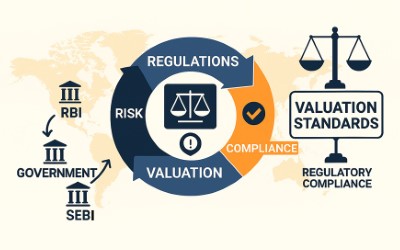
Relevance of Regulatory Landscape in Shaping the Valuation Approach
Regulations as a Determinant for Valuation Judgments
Determining the optimal valuation methodology requires a rigorous alignment of the company’s business continuity, financial health, and the economic environment in which it operates. Based on these factors, the valuer decides on the application of either the Income Approach, Market Approach, or Asset Approach to determine a company’s valuation.
The Income Approach serves as a forward-looking lens, best suited for stable, cash-generating businesses where value is derived based on future earnings capability. The Market Approach provides a practical benchmark by comparing the company against peers operating in similar active markets. Asset Approach works where business continuity is uncertain or focusing on underlying assets is more important than considering speculative growth.
Selecting the appropriate valuation approach is therefore not just about following the conventional rules, but it also depends on the business situation and regulatory environment.
Regulatory Landscape as a Valuation Sensitivity
While valuers generally factor in historical performance, business outlook, capex and borrowing plans, regulatory developments often remain underweighted despite their ability to materially alter valuation outcomes. Regulatory changes can directly impact cost structures, revenue drivers, operational flexibility, and investor risk perception — all of which flow into valuation assumptions.
In regulated industries, failure to anticipate regulatory shifts or assess compliance readiness can result in optimistic projections that may quickly become unsustainable. Let’s look at a few examples below:
1.IndiGo: Regulatory Preparedness and Earnings Visibility
Consider the example of IndiGo, India’s largest airline by market share. The revised Civil Aviation Requirements (CAR) relating to Flight Duty Time Limitations (FDTL) issued by the DGCA materially altered operational realities in Indigo’s case.
Following the implementation deadline, IndiGo faced widespread flight cancellations driven by pilot availability constraints and scheduling challenges. Despite a transition window of nearly two years, operational preparedness proved insufficient, leading to network disruption and adverse market reaction. Analysts responded by materially revising earnings expectations downward, reflecting heightened uncertainty around execution capability and cost escalation.
The impact of this was clearly visible on the market price of Indigo’s share.
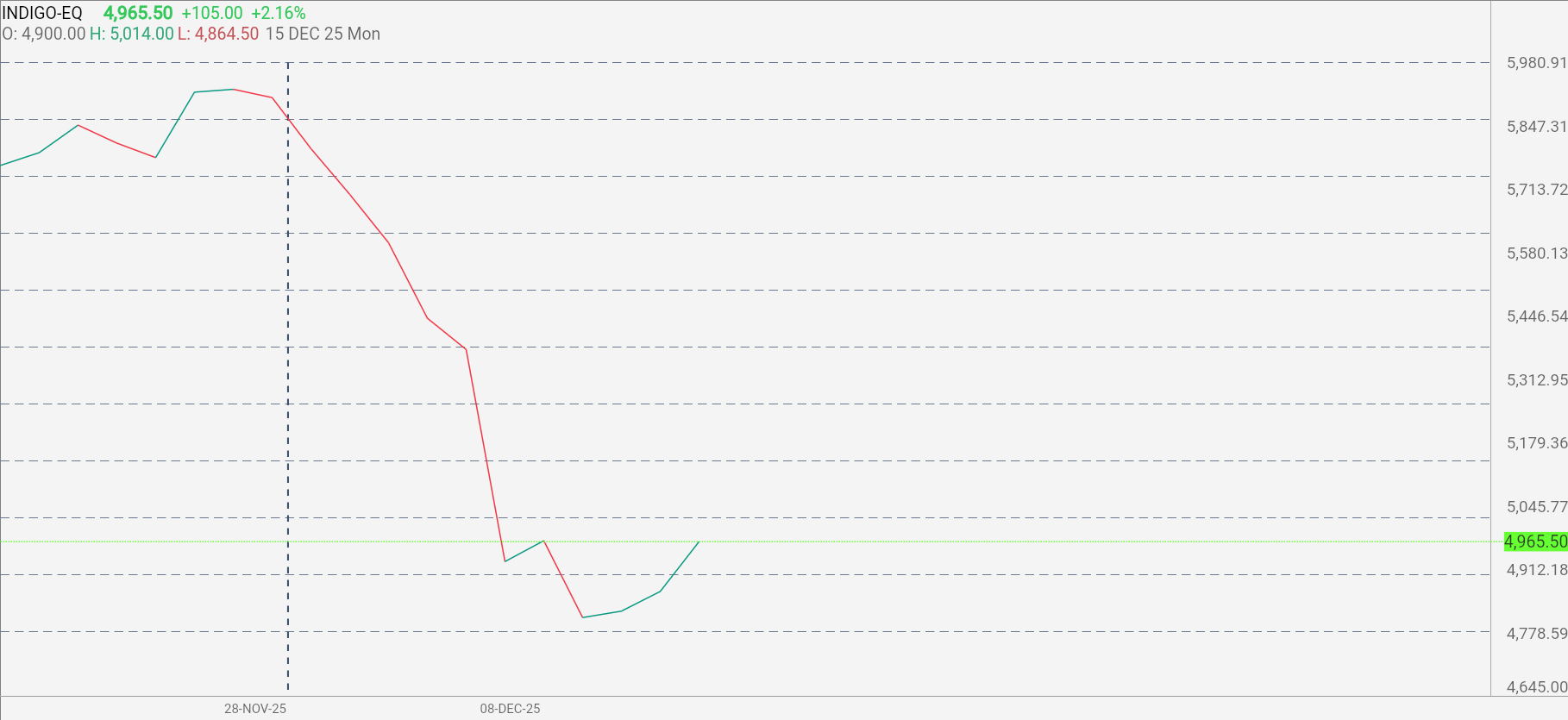
Source: NSE
This episode demonstrates how regulatory preparedness materially affects earnings visibility and the risk assumptions embedded in valuation models.
2.Paytm Payments Bank: Regulatory Non-Compliance and Going-Concern Risk
While some regulatory changes lead to downward valuation adjustments, others fundamentally challenge business continuity. Paytm Payments Bank (PPBL) provides a compelling illustration. Persistent compliance shortcomings culminated in the Reserve Bank of India (RBI) imposing severe operational restrictions in early 2024, including a prohibition on accepting new deposits.
The regulatory action had immediate spillover effects on its parent entity, One97 Communications, with the stock declining sharply within days, erasing substantial market cap.
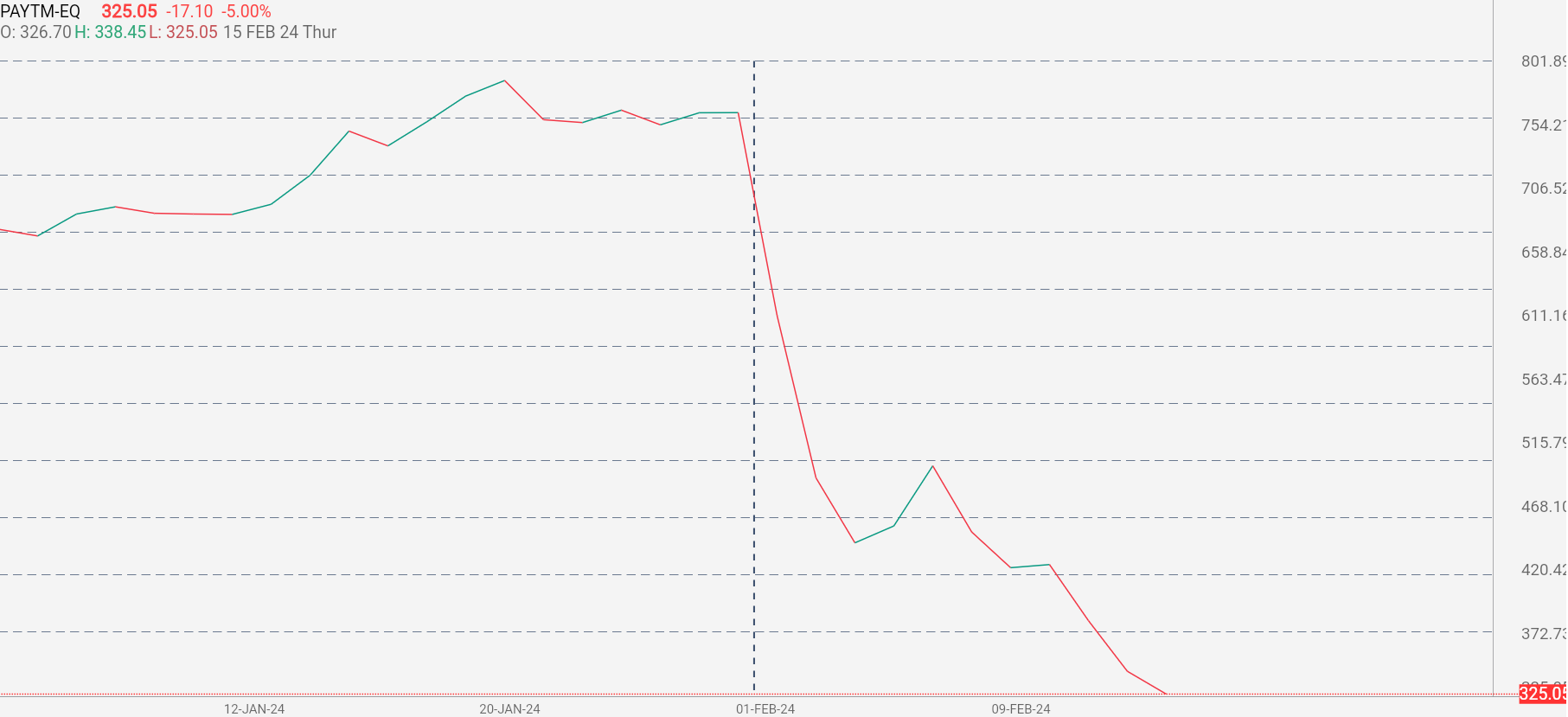
Source: NSE
The restriction on deposit inflows materially impaired the bank’s revenue engine and raised concerns regarding the sustainability of its business model. From a valuation standpoint, such intervention introduces material uncertainty around the entity’s ability to continue as a going concern. Businesses that could earlier be valued using Income or Market approaches may now need reassessment under the Asset Approach, where recoverability of tangible assets takes precedence over uncertain future cash flows.
3.Online Real Money Gaming: Industry-Wide Regulatory Shifts
Regulatory risk is not limited to individual companies; it can reshape entire industries. For instance, India’s Online Real Money Gaming (ORMG) sector, once a fast-growing market with hundreds of start-ups and a significant share of investor funding, faced severe disruption following the introduction of the Promotion and Regulation of Online Gaming Act (PROGA), 2025.
The revised regulatory framework curtailed real-money gaming activities, leading to operational shutdowns, lay-offs, and erosion of enterprise value across the sector. An industry which was projected to grow rapidly over the medium term instead faced severe uncertainty around business continuity and future viability due to regulatory interventions.
For instance, this change curtailed the operations of Pokerbaazi considerably, and the impact of this change was clearly visible on stock prices of Nazara Technologies, who was one among the major investors.
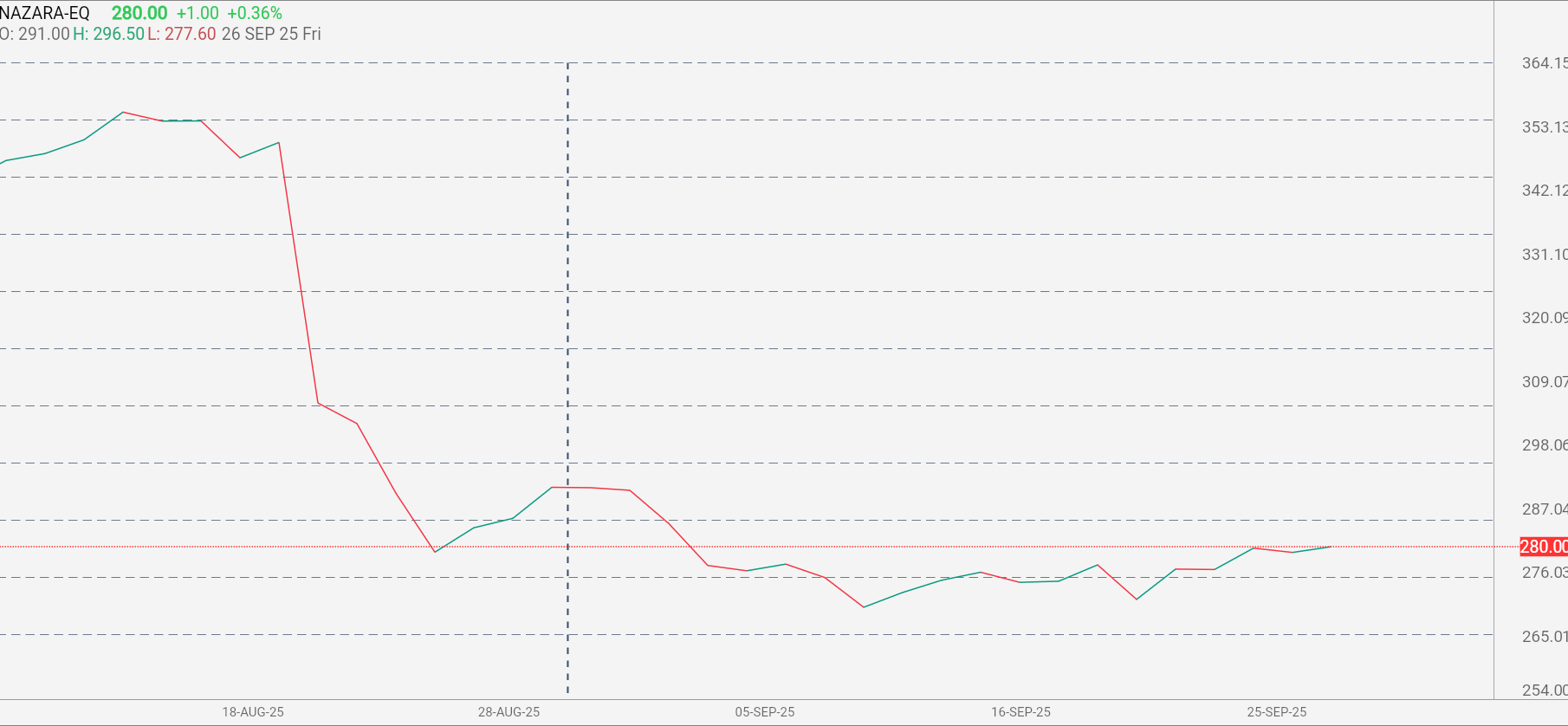
Source: NSE
Such developments make historical growth trajectories and comparable market multiples largely irrelevant, forcing valuers to reassess assumptions, increase risk premiums, and, in certain cases, reconsider the choice of valuation methodology altogether.
Regulatory Influence on Valuation Approach Selection
Above examples reinforce that regulatory developments influence not only valuation outcomes, but also the appropriateness of valuation approaches:
- Income and Market Approaches rely on regulatory stability, predictable cash flows, and business continuity.
- Asset Approach gains relevance when regulatory action threatens business and revenue sustainability or introduces going-concern uncertainty.
- Regulatory non-compliances also often necessitate adjusting the valuation assumptions like higher discount rates, compressed valuation multiples etc.
Conclusion: Regulatory Landscape as a Core Valuation Variable
Ultimately, valuation outcomes are shaped not only by business strategy, historical performance, and capital investment, but also by the regulatory landscape and the target company’s compliance readiness. Regulatory changes have the power to alter revenue models, invalidate projections, and redefine risk profiles.
For valuation professionals, regulatory awareness must extend beyond mandatory disclosures. Continuous monitoring of regulatory developments, assessment of compliance preparedness, and timely incorporation of regulatory risk into valuation models are essential to ensure that valuation methodologies, assumptions and outcomes are both analytically sound and professionally defensible.
Valuation should always be undertaken considering the regulatory landscape in which the company operates. Overlooking regulatory risks can significantly impact assumptions, outcomes, and even the choice of valuation approach.

Regulatory landscape of Fintech companies
Navigating the regulatory maze for Fin-techs in India
- It is common knowledge that the financial institutions are the most stringently regulated institutions. Fin-techs, delivering financial services through technology, are creatures of the recent past and their regulation is a grey area and is continuously evolving.
- The argument of Fin-techs that they are “not Financial Institutions” to be strictly regulated is no longer a viable argument. As recently, Simpl, a BNPL based fintech company was asked to stop operations by RBI as internal investigations revealed contravention of Payments and Settlements Systems Act, 2007. Thus, turning a blind eye to the regulatory landscape is not a viable option for fin-techs.
Regulatory Landscape
The Regulatory landscape can be divided in twofold:
1. Regulators
Given that the Fin-techs are a creation of the neo-tech age, there are multiple regulators and can be succinctly put as follows:
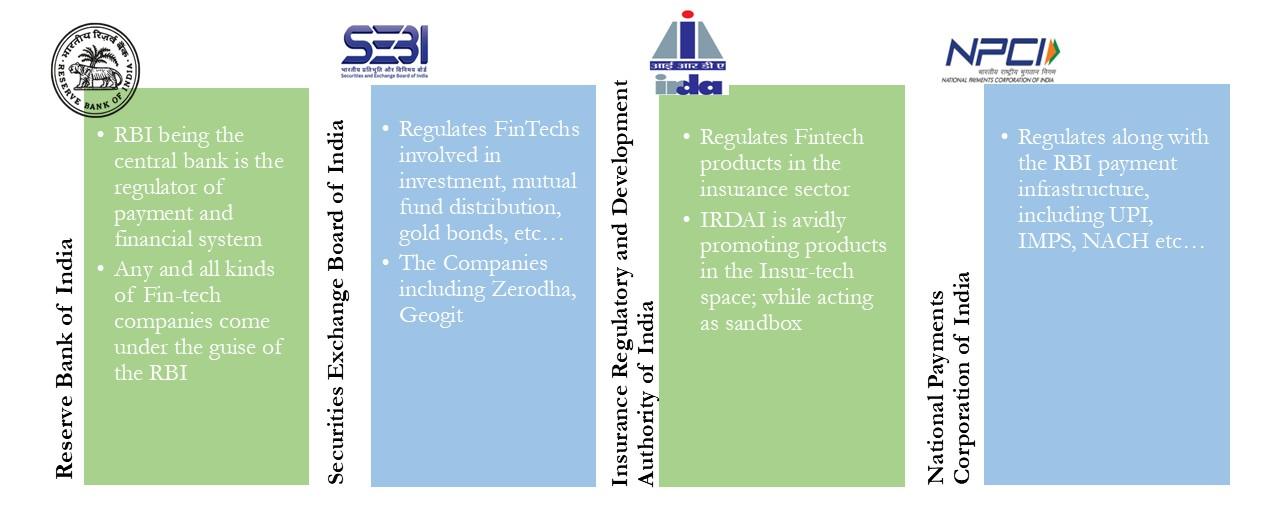
- In additional to these regulators, the fin-tech space is also regulated by Ministry of Information and Technology, Ministry of Corporate Affairs, Department for Promotion of Industry and Internal Trade, Central Board for Direct and Indirect Taxes, State labour departments, and many more. Phew!
- This only indicates that the Indian regulators are multi-fold and multifarious, lacking a single window mechanism for fin-tech companies.
2.Product based legislations:
We can broadly classify the fin-tech products as follows and identify the applicable special laws hereinbelow:
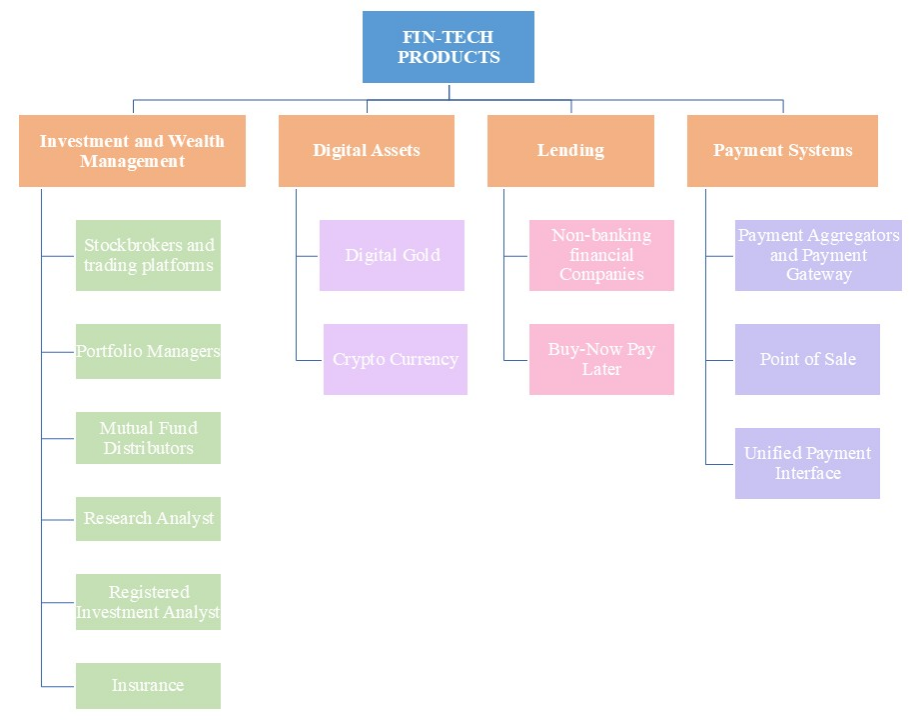
- Investment and Wealth Management:
- Stockbrokers and Trading Platforms:
Regulation: Securities and Exchange Board of India (Stock Brokers) Regulations, 1992 along with rules prescribed by stock exchanges - Portfolio Managers:
Regulation: SEBI (Portfolio Managers) Regulations, 2020 - Mutual Fund Distributor
Regulation: Need to be registered with Association of Mutual Funds in India (“AMFI”) and follow the AMFI’s code of conduct. They are also required to pass the NISM V-A certification to receive an AMFI Registration Number (“ARN”) - Research Analyst
Regulation: SEBI (Research Analysts) Regulations, 2014 - Registered Investment Advisers
Regulation: SEBI (Investment Advisers) Regulations, 2013 - Insurance
Regulation: IRDAI (Insurance Web Aggregators) Regulations, 2017, IRDAI (Registration of Corporate Agents) Regulations, 2015 - Digital Assets
- Lending
- i.NBFC – Digital Lending Platforms:
Regulation: Master Direction on Non-Banking Financial Company – Scale Based Regulation Directions, 2023 - Buy-Now Pay-Later:
Regulation: Reserve Bank of India (Digital Lending) Directions, 2025. Some BNPL’s also obtain NBFC licenses. - Payment Systems:
- Payment Aggregators and Payment Gateways:
Regulation: Payment and Settlement System Act, 2007 along with Guidelines on Regulation of Payment Aggregators and Payment Gateways issued by the RBI dated March 17, 2020 - Point of Sale
Regulation: Draft RBI (Regulation of Payment Aggregators) Directions, 2025 - Unified Payments Interface
Regulation: RBI Regulates UPI under Payment and Settlement System Act, 2007 and NPCI manages operational aspects of UPI
These platforms act as middlemen between investors and the capital markets, providing tools for trading, research, and financial advice through both consumer apps and business partnership models.
Digital Assets like digital gold, crypto currency are still a regulatory grey area in India. The government has only introduced taxation on such assets.
Lending has become one of the most active areas in India’s fintech landscape, driven by platforms that provide quick, convenient, and technology-enabled credit through online and mobile channels. Using advanced data tools, these companies handle everything from credit evaluation and customer onboarding to loan disbursal and repayment.
In recent years, the RBI has tightened its supervision of this sector to address issues related to consumer safety, operational transparency, and potential gaps in regulatory compliance.
Payment systems facilitate the transfer of funds between individuals, and entities. This acts as a backbone in this digital economy.
Conclusion:
The regulatory environment governing the fintech industry in India is vast, multifaceted, and continuously evolving. With multiple regulators, complex product-based legislations, and increasing oversight from authorities like the RBI and SEBI, compliance is no longer optional. Fintech companies must approach regulatory obligations with serious consideration and seek expert professional guidance to navigate these intricate frameworks. Proactive compliance and sound legal consultation are essential to avoid regulatory hurdles and ensure sustainable, lawful business operations in an increasingly stringent ecosystem.
- Fin-tech industry is rapidly growing due to digitalization and government initiatives for promoting financial inclusion across India.
- Given the strict and penal nature of regulations for finance Industry, it is important that businesses in fin-tech industry be appraised of the regulations applicable to them to avoid any future repercussions.
- In this article, we give a bird’s eye view of the regulatory landscape for fin-tech companies in India.

Article on Reverse Flipping structures
Reverse Flipping – Return to Homeland
A. What is Reverse Flipping
- Reverse flipping is when an Indian-founded company, after incorporating its parent company overseas for advantages like access to global capital and favorable tax regimes, shifts its legal domicile and operations back to India.
- This counter-trend to the earlier "flip" is driven by India's improving economic landscape, more favorable government policies etc., allowing these companies to become wholly Indian entities once again.
- This has been captured in the diagram below:
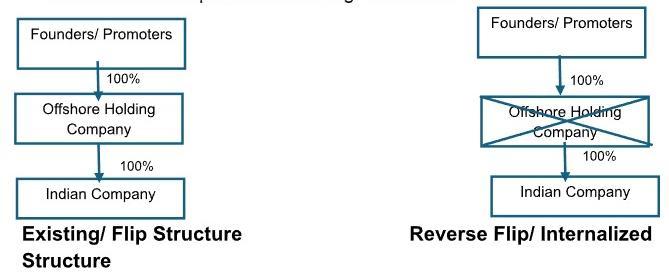
B. Why companies preferred overseas jurisdiction
Companies earlier preferred to set up in overseas jurisdictions on account of the following reasons (included but not limited to)
- Ability to list on overseas stock exchange, attract a larger investor base, access to foreign capital via offshore Venture Capital
- Achieve Higher valuation in foreign markets providing attractive exit
- Increased Intellectual Property protection (Stringent IP protection laws)
- Favorable regulatory requirements, avail tax benefits resulting in ease of doing business
- Lucrative global markets and brand recognition
- Favorable tax regimes for repatriation of profits to investors/ exit
The jurisdictions favoured for flipping were Singapore, UAE, Netherlands, Luxembourg, the Cayman Islands, Mauritius, the United States, and the United Kingdom
C. What is the drive to shift back to India
In the recent times, many Indian Companies have considered to return back to India majorly on account of the following:
- Investor and business friendly reforms made in Indian tax and regulatory regulations viz. Ease of the regulatory compliances – deployment of digital platforms for regulatory filings and compliances, reduction in tax rates etc.
- Demographic advantage – Massive customer base, youthful and dynamic workforce, competitive costs of workforce etc.
- Increased access to the capital markets – Maturity of Indian IPOs market viz. measures taken by SEBI to curtail the approval timelines, streamlining the processes etc.
- Magnificent growth opportunities in diverse sectors in India boosting the return of investment
- Massive digital growth, digital infrastructure (such as UPI), acting as a global technology hub, recent thrust to AI, blockchain development etc.
- Emergence of GIFT City - with tax incentives, relaxed FEMA regulations, and access to international listing opportunities
- Strategic Global positioning viz. preferred alternative destination for manufacturing, strengthening global ties viz. FTAs with major economies like EU, UK etc.
D. Ways of Reverse Flipping
Some of the prevalent structures considered for reverse flipping to Indian jurisdiction are as follows:
1. Inbound Merger of offshore Hold Co into the India Co
Offshore Hold Co would be merged with the Indian Co. In consideration of merger, India Co would issue shares to the shareholders of the offshore Hold Co i.e. founders/ promoters
Key Tax and regulatory considerations
- Income-tax
- Merger to be tax-neutral subject to prescribed conditions
- If India Co has carried forward losses, such losses would lapse
- GAAR implications if transaction lack commercial substance
- Valuation requirements to be complied with
- Tax implications as per the laws of the overseas jurisdiction to be considered
- Company Law
- Inbound mergers to comply with section 234 of the Companies Act, 2013 (“CA, 2013”) – Fast Track Merger provisions under section 233 of the CA, 2013 apply
- Company law of the Hold Co jurisdiction to permit the inbound merger
- FEMA
- FEMA (Cross Border Merger) Regulations to be complied with - issue of shares to comply with pricing guidelines, entry routes, sectoral caps etc. under FEMA FDI regulations
- Valuation of India Co and Hold Co to be done as per internationally accepted valuation principles
- RBI approval required – compliance with the FEMA (Cross Border Merger) Regulations deemed as prior RBI approval
- Stamp Duty implications in the respective state to be considered
2. Transfer of shares of India Co by Hold Co to Founders/ Promoters
- Under this option, Hold Co transfers the shares of India Co to Founders/ Promoters (consideration to remain outstanding)
- Hold Co to liquidate and distribute its net assets to Founders/ Promoters (shareholders)
Key Tax and regulatory considerations
- Income-tax
- Transfer of shares – Subject to capital gains tax in India, Exemption under the respective DTAA may be explored.
- Valuation provisions under IT Act to be complied
- Withholding taxes to be deducted - Section 195 of IT Act
- Liquidation of Hold Co - No India tax implications for Hold Co. For non-resident promoters, No India tax implications. For resident promoters (LLP), implications as per section 46. Laws of overseas jurisdiction to be considered.
- Carried forward business losses in India Co would lapse
- Company Law
- Changes to the shareholding of India Co to be captured
- In case of liquidation, the laws in country of Hold Co to be complied with
- FEMA
- Transfer of shares – For Transfer between non-residents, Valuation norms/ reporting as per FEMA FDI regulations not required. For transfer to resident promoter (LLP), Valuation and reporting requirements to be complied with
- Stamp Duty implications on transfer of shares to be considered
3. Swap of shares of Hold Co against the shares of New India Co
- Shareholders of Hold Co. to set up a New India Co – Shareholders to transfer the shares of Hold Co to New India Co. in exchange of shares of New India Co
- Hold Co to liquidate and distribute its assets and liabilities (including shares in the existing India Co) to New India Co.
Key Tax and regulatory considerations
- Income-tax
- Indirect transfer tax implications may arise for non-resident promoters. For Indian promoters (LLP), swap would be taxable
- Valuation requirements under IT Act to be complied
- Withholding taxes to be deducted as applicable
- Liquidation of Hold Co - No India tax implications for Hold Co. Taxability on New India Co as per section 46
- Liquidation of Hold Co - No India tax implications for Hold Co. Taxability on New India Co as per section 46
- Carried forward business losses, if any, in India Co may lapse
- Company Law
- Investment thresholds under section 186 of CA, 2013 to be complied with by New India Co
- Changes in shareholding of New India Co and existing India Co to be recorded – Recording of Investments in New India Co.
- In case of liquidation, the laws in country of Hold Co to be complied with
- FEMA
- Permissible as per FEMA regulations
- Valuation norms under both FDI and ODI regulations to be complied with
- However, very important that ODI limits under FEMA ODI regulations are complied with – if not complied, RBI approval required - other consequences in case of non-compliances
- Suitable reporting/ filing to be made under the FEMA FDI/ ODI regulations
- Liquidation of Hold Co - Pricing guidelines, reporting requirements under FEMA ODI regulations to be complied with
Other ways to undertake reverse flipping include Re-domiciliation of offshore Hold Co to India
E. Companies which have reverse flipped their structures recently
Few companies which have adopted reverse flipping structures to return to India are below:
- Phone Pe – Reverse Flip from Singapore - share transfer
- Groww – Reverse Flip from USA - Inbound merger
- Pepperfry - Reverse Flip from Singapore - Inbound merger
- Flipkart – Redomiciling Singapore parent entity to India
- Zepto – Reverse Flip from Singapore - Inbound merger
F. Consideration of GIFT IFSC as a hub for Reverse Flipping
IFSCA introduced International Financial Services Centres Authority (Listing) Regulations, 2024 to provide access to global capital without domestic listing and has set up Padmanabhan committee to develop a plan.
Key recommendations made by the Committee for reverse flipping to GIFT IFSC
- GIFT IFSC - considered as nodal office for incorporation and other regulatory approvals
- Tax neutral structure for relocation of Hold Co and its shareholders
- Grandfathering for existing investment of Hold Co
- No lapse of losses of the India Co
- Participation exemption for GIFT IFSC Hold Co on levy of capital gains tax
- Concessional tax regime for Dividend in the hands of GIFT IFSC Company
Once the above recommendations are finalized, GIFT IFSC would be a preferred destination for reverse flipping. Companies to keep a close eye on the finalization of these recommendations.

Power of Intangibles - An Indian Perspective
Valuation of Intangibles: An Indian Perspective
Introduction
In today’s knowledge‑driven economy, a company’s true value often lies in what cannot be seen on its balance sheet. Intangible assets—brands, trademarks, patents, customer relationships, source codes, know-how’s, and human capital—have become the new contributors of growth. Globally, many MNC firms derive a majority of their market value from intangibles and India is no exception.
Conventional Valuations to Brand Value: A Shift in Indian Valuations
Traditionally, Indian businesses were valued by their earning potential or in some case by their tangible assets—land, machinery, inventory, and buildings. This has taken a paradigm shift in a digital and services‑led economy. Today, a startup with few physical assets can command a billion‑dollar valuation solely on the strength of its technology, brand value, customer relationships, goodwill and other intellectual properties.
When Nykaa listed, for instance, its physical assets were limited. But investors back‑valued its strong brand and customer loyalty. Similarly, Indian IT majors like Infosys and TCS derive the lion’s share of their enterprise value from their IPs, proprietary platforms, and deep client relationships rather than heavy plants or equipment.
A striking example is Flipkart’s acquisition by Walmart in 2018. Walmart paid US $16 billion for a 77% stake—implying a total valuation exceeding US $20 billion—despite Flipkart having minimal fixed assets. Walmart wasn’t acquiring warehouses or factories; it was buying reach, brand trust, and data.
Intangibles: The Invisible Asset That Commands Premiums
Brand Value
In India, brand value often drives valuation multiples well beyond what physical assets justify. Taking Hindustan Unilever (HUL) as an example: its market capitalization is approximately ₹5.7 lakh crore as of November 2025, and it’s trading at a price-to-book ratio above 11x. Its factories and machinery can be replicated, but the consumer trust in its brands like Surf Excel and Dove is far harder to reproduce. That trust allows HUL to command premium pricing and retain investor confidence.
A contrast in the Indian FMCG landscape is Patanjali versus Dabur. While Patanjali rapidly expanded distribution, concerns over its governance, product consistency, and brand sustainability caused its valuation multiples to shrink. Meanwhile, Dabur, with over 135 years of heritage, continues to command stable multiples—testament to how long‑term brand and reputation resilience matters more than reach alone.
Intellectual Property, R&D and the Innovation Premium
In sectors like pharmaceuticals, biotech, and software, intellectual property is often the main value driver. Consider Biocon: its market capitalization is around INR 52 thousand crores as of November 2025, and its stock often reacts sharply to R&D breakthroughs and regulatory milestones. In such businesses, patents, licensing deals, and pipeline potential overshadow factories or land.
Customer Networks & Platform Economics
Intangibles play a central role in consumer tech and platform businesses. Paytm, at its IPO, was valued at nearly ₹1.4 lakh crore largely on the strength of its registered users and merchant network, not merely on its earning potential or its assets.
In non‑digital sectors too, customer loyalty and network effects matter. Amul, structured as a cooperative, does not own vast factories proportional to its reach, but it’s the bond with its registered consumers which acts as a powerful intangible.
Valuing Intangibles: Methods & Practical Hurdles
Most Common valuation approaches:
- Relief‑from‑Royalty Method (Income Approach) – Brands, Trademarks, Patents etc.
- Multi Period Excess Earnings Method (Income Approach) – Customer relationships, Tech Platforms, Non-compete etc.
- Replacement Cost / Reproduction Cost (Cost Approach) – Workforce, IPs which are generally not the primary business drivers
Yet in India, implementing these has challenges:
- Lack of comparable benchmarks and data in public domain
- Identification of primary business drivers and applying the appropriate valuation methodologies
- Revenue / Profits attribution in case of valuing multiple Ips
- Unrecognized IP’s in Books
- Dependence on Subjective Assumptions
Conclusion: Recognize What Lies Beneath
In India’s evolving valuation landscape, ignoring intangibles is as good as turning our back to reality. From Flipkart’s multibillion-dollar acquisition to HUL’s market cap built on its customer base, we see that real value often hides beyond books and numbers. As India pivots deeper into digital and service economies, intangibles—brands, patents, trademarks, customer relationships, technology platforms, human resource capital will matter even more.
For valuation professionals and investors, the challenge is to supplement conventional valuation models with a detailed assessment of value-generating intangibles. Only then can businesses be fairly valued. Companies should not be penalized in their valuations for having invisible yet powerful assets in the form of intangibles.

M&A Made Simple: How Deals Shape India’s Business Landscape
India's M&A scene is booming. From billion-dollar tech deals to strategic healthcare mergers, the country is becoming a hotbed for corporate restructuring. But what does it really take to pull off a merger or acquisition in India?
Why India is a Magnet for M&A
India's economic growth, investor-friendly reforms, and booming sectors like fintech, renewable energy, and healthcare are attracting global attention. With relaxed FDI norms and a surge in IPOs, companies are seeing India as a land of opportunity.
Take the Walmart-Flipkart deal—a landmark acquisition that showcased India's potential in e-commerce. Or the HDFC Bank-HDFC Ltd merger, which created a financial powerhouse.
Types of M&A – With Examples
There are different types of M&A Transactions. Here's a simple breakdown of the types with examples to relate -
- Horizontal Merger: Two companies in the same industry join forces.
Example: Vodafone India and Idea Cellular merged to become one of India's largest telecom operators. - Vertical Merger: Companies at different stages of the supply chain merge. Objective is to improve operational efficiency, reduce costs, reduce competition, increasing market share in a particular industry, benefit from the assets, capabilities and Intellectual properties acquired
Example: Reliance Industries acquiring Network18, integrating media into its digital ecosystem. - Congeneric Merger: Companies in related industries but different products.
Example: A beverage company acquiring a snack brand. - Conglomerate Merger: Companies from unrelated industries merge. The principal reason for a conglomerate merger is utilization of financial resources, enlargement of debt capacity, foray into diverse businesses.
Example: Tata Group's acquisition of Corus Steel, expanding into global steel manufacturing. - Market-Extension Merger: It is done with the objective to expand geographical reach and customer base.
Example: A South Indian food chain merging with a North Indian counterpart. - Product-Extension Merger: Merger takes place between companies offering related products in the same market. It is done with the objective to broaden product lines and enhance customer offerings.
Example: A smartphone brand acquiring a smart accessories company.
Takeovers vs. Acquisitions
A takeover is when one company gains control of another—often by buying a majority stake. An acquisition can be more strategic, involving asset transfers or business restructuring. This can be through a Slump sale for instance.
Example: Zomato's acquisition of Blinkit was a strategic move to enter quick
Legal & Regulatory Maze
There are multiple regulations that come into play during a Corporate Restructuring Action. Here are a few common and significant ones -
Company Law
- Scheme involving mergers, demergers etc. must require approval from NCLT.
- Compliance with the provisions of Section 230 to 232 of the Companies Act (viz. approval from shareholders, creditors, obtaining valuation, approval from other government authorities etc.)
- In cases of merger between holding and wholly owned subsidiary entities, fast track merger procedure under section 233 of the Companies Act needs to be complied with (Approval from Regional Director instead of NCLT)
- In case of cross border mergers, provisions of section 234 of the Companies Act needs to be complied
- In case of takeover by way of investment in new shares of the Company, provisions of section 186 of the Companies Act relating to investment limits needs to be complied with
- In case of preferential allotment of shares, valuation of shares from registered valuer
SEBI Rules
- If acquiring 25% or more in a listed company, an open offer is mandatory.
- Preferential allotments must meet pricing and lock-in norms.
- Stock exchanges must approve merger schemes before NCLT filing.
- Submission of valuation reports, auditor's certificate, no objection letters from lenders is also a prerequisite before NCLT filing
Competition Law
Where a combination (acquisition or merger) crosses the Assets or turnover related thresholds provided under Competition Act, 2002, notification to Competition Commission of India needs to be made
FEMA Compliance
- Foreign investments must follow pricing norms, sectoral caps, and reporting rules under Non Debt Instruments Rules, 2019
- Outbound mergers need to comply with FEMA ODI regulations.
Income Tax
- Mergers can be tax-neutral under Section 47, but conditions apply.
- Compliance with conditions under section 2(1B) and 2(19AAA) of the IT Act and Section 47 for tax neutrality
- Conditions relating to carried forward losses under section 72A, cost of acquisition of shares in amalgamated company, holding period of shares etc. to be complied with
- Valuation reports are crucial to comply with tax laws under Sections 50CA and 56(2)(x).
Other Considerations
- GAAR: GAAR and Principal Purpose test – Arrangements are tested for substance and for arm's length pricing , to have non-tax commercial reasons
- GST: Generally not applicable if the transfer is a going concern but would need specific analysis
- Stamp Duty: Varies by state and can be significant.
Final Thoughts
M&A in India is a powerful tool for growth, diversification, and innovation. But it's not just about strategy—it's about compliance, valuation, and timing. Whether you're a startup eyeing expansion or a global player entering India, understanding the legal and tax landscape is key.
Always consult legal and financial advisors before diving into a deal. The right structure can save you time, money, and regulatory headaches.

NRI investment in India: Love for homeland meets FEMA boundaries
For many Non-Resident Indians (NRIs), investing in India is more than just a financial move—it’s a way to stay connected to their roots. Whether it’s buying a home in your hometown, backing a promising startup, or simply growing your wealth in a familiar market, the emotional pull is strong. But as with all things financial, there are regulations to comply with.
Let’s explore how NRIs and Overseas Citizens of India (OCIs) can invest in India while staying fully compliant with FEMA. From property to pensions, repatriation to reporting, here’s a summary of the key aspects to consider
FEMA: Your Investment GPS
FEMA governs all cross-border financial transactions involving foreign exchange. That includes investments made by NRIs, OCIs, and Persons of Indian Origin (PIOs). Its goal? To facilitate external trade and payments while keeping India’s foreign exchange market stable and well-regulated.
Under FEMA:
- An NRI is an Indian citizen residing outside India.
- The Reserve Bank of India (RBI) is the key regulator, issuing rules, notifications, and Master Directions that guide NRI investments.
Real Estate: What You Can Own
NRIs can acquire immovable property in India—but with a few caveats. You’re free to buy:
- Residential or commercial property
- Property received as a gift from a close relative (resident Indian, NRI, or OCI)
- Property inherited from a resident or a compliant non-resident
- Agricultural land
- Farmhouses
- Plantation property
However, you cannot purchase:
You can transfer property to resident Indians or other NRIs, as long as it’s not in the restricted categories. All payments must be made through banking channels or from compliant non-resident accounts.
Repatriation vs. Non-Repatriation: Know the Difference.
- Repatriation Basis: You can send your capital and profits back abroad. It’s ideal if you want liquidity outside India.
- Non-Repatriation Basis: Your investment is treated like a domestic one. You can’t freely send the money back overseas, but you can reinvest or use it within India.
Repatriation Investments: What’s Allowed
NRIs can invest on a repatriation basis in several ways:
Where You Can Invest
- Equity instruments of listed Indian companies (via designated branches)
- Units of domestic mutual funds (with more than 50% equity exposure)
- Shares in public sector enterprises under disinvestment
- Subscription to the National Pension System (NPS)
Investment Limits for investment in listed Indian companies
- Individual NRI: Max 5% of paid-up capital
- All NRIs combined: Max 10%, extendable to 24% with shareholder approval
Mode of Payment
- Inward remittance through banking channels
- Funds from NRE account (as per FEMA Deposit Regulations, 2016)
- For stock market investments, your NRE account must be designated as a Portfolio Investment Scheme (PIS) account
- Mutual fund investments can be made from NRE/FCNR(B) accounts
- NPS subscriptions can be funded from NRE/FCNR(B)/NRO accounts
Remittance of Sale Proceeds
- Equity sale proceeds (net of taxes) can be repatriated or credited to your NRE (PIS) account
- Proceeds from mutual funds and NPS can be repatriated or credited to NRE (PIS)/FCNR(B)/NRO accounts, based on your preference
Non-Repatriation Investments: What’s on the Table
If you’re not looking to send your money back abroad, non-repatriation investments offer more flexibility and fewer limits.
Where You Can Invest
- Equity instruments of Indian companies
- Units of investment vehicles
- Capital contribution to LLPs, firms, or proprietary concerns
- Convertible notes issued by startups
These investments are treated as domestic, just like those made by resident Indians.
Mode of Payment
- Inward remittance through banking channels
- Funds from NRE, FCNR(B), or NRO accounts
What You Can’t Invest In
- Nidhi companies
- Agriculture or plantation activities
- Real estate business or farmhouses
- Transfer of development rights
Remittance of Sale Proceeds
- All sale or disinvestment proceeds (net of taxes) must be credited only to your NRO account
- No repatriation of the original investment or capital gains is allowed
LEC (NRI): The Reporting Rule You Can’t Ignore
Every time you buy or sell equity instruments on Indian stock exchanges, your Authorised Dealer (AD) bank must report the transaction to the RBI using Form LEC (NRI).
What’s your responsibility? Keep your AD bank informed. If they don’t know about your transaction, they can’t report it—and that could lead to compliance issues.
Regulatory Filing Requirement for Share Transactions When an NRI acquires shares in an Indian company—either through a primary issuance (fresh allotment) or a secondary transaction (transfer from an existing shareholder)—certain filings are mandated under FEMA. Specifically:
- Form FC-GPR must be filed for primary issuances.
- Form FC-TRS must be filed for secondary transfers.
Importantly, the responsibility for filing these forms lies with the resident party to the transaction, not the NRI investor. This ensures regulatory compliance while simplifying the process for non-resident participants.
In Conclusion
Investing in India as an NRI is a beautiful blend of emotion and opportunity. It’s a way to stay connected, contribute to India’s growth, and build wealth in a market you understand. But it’s also a journey that requires awareness and adherence to FEMA’s rules.
Whether you’re buying property in your hometown, trading stocks in Mumbai, or backing a startup in Bengaluru, make sure your investments are not just heartfelt—but also fully class="mb-20compliant

Group of Companies Doctrine: Cox and Kings and its Judicial Aftermath
What is the Group of Companies Doctrine?
The Group of Companies Doctrine allows an arbitration agreement signed by one company in a corporate group to bind non-signatory affiliates, provided certain conditions are met.
This doctrine challenges traditional legal principles like:
- Separate legal personality
- Privity of contract
- Express consent to arbitration
The Supreme Court’s Findings in Cox and Kings Limited v. SAP India Private Limited (2023)
-
The Court interpreted sections 2(1)(h) (defines “Party” as Party to an arbitration agreement) and 7 (essentials of arbitration agreement) of the Arbitration Act, 1996 (“Act”) to include both signatories and non-signatories as Party.
Further the Court highlights that the central tenet of section 7 of the Act lies in the mutual interests of the parties rather than their express consent to be bound by an arbitration agreement.
- Mutual Intent of Parties
- Relationship of non-signatory to a signatory
- Composite nature of transaction
- Performance of contract
- Participation of non-signatory
Judgments Post Cox and Kings
- Nearly two years after the Supreme Court’s landmark ruling in Cox and Kings Ltd. v. SAP India Pvt. Ltd., the Group of Companies Doctrine continues to evolve under the Indian arbitration law.
- A recent and notable development is the Supreme Court’s decision in Adavya Projects Pvt. Ltd. v. Vishal Structurals Pvt. Ltd. (2025), relaxed procedural requirements to join non-signatories to arbitration proceedings.
- In this case, the appellant invoked arbitration against one respondent (a partner in an LLP) but later sought to include the LLP itself and its CEO/directors in the proceedings.
- What was the problem here? It was the fact that these non-signatories had not received notice under Section 21 of the Arbitration and Conciliation Act, nor were they part of the original application for appointment of the arbitrator.
- The Delhi High Court upheld the arbitrator’s decision to exclude the LLP and its CEO/directors, citing procedural lapses—primarily the lack of notice and formal joinder.
Supreme Court’s Intervention
- In a significant reversal, the Supreme Court held that:
- Though service of notice under Section 21 is mandatory to commence arbitration, but non-service alone does not bar the arbitral tribunal’s jurisdiction over such non-signatories.
- The Court reaffirmed the principle of kompetenz-kompetenz—the tribunal’s authority to rule on its own jurisdiction codified under Section 16 of the Act.
- The Court clarified that while the referral court’s prima facie examination is not binding on the tribunal; the tribunal must examine the existence of factors for application of the Doctrine. The factors being language of the agreement, conduct of parties, nature of transaction etc.
- It held that the tribunal must assess whether non-signatories effectively consented to the arbitration agreement based on conduct and the terms of the LLP Agreement.
- In essence, this clarifies that absence of a Section 21 notice does not automatically exclude parties from an arbitration. Instead, the tribunal must apply the factors under Group of Companies doctrine to determine its jurisdiction over such parties.
Conclusion
The Supreme Court in Cox and Kings Limited v. SAP India Private Limited significantly expanded the Group of Companies Doctrine, allowing arbitration agreements to bind both signatories and non-signatories where commercial realities and mutual intent justify it. Post Cox and Kings, the doctrine’s scope remains evolving.
While drafting multi-party arbitration agreements, extreme caution must be exhibited in drafting joinder of party clause. However, given that this is an evolving Doctrine express exclusion of joinder of parties in arbitration agreement is surely a rickety bridge. While the Court has provided guiding factors, time will tell how consistently and concretely these will be applied to define the contours and limits of the Group of Companies Doctrine in India.

Beyond the Buzz: What Makes a Startup Truly Valuable Today?
Valuation has evolved from backroom metric to a boardroom obsession. A decade ago, it was rarely part of mainstream startup conversations—today, it’s front and center. But let’s be clear that valuation isn’t just a number on a spreadsheet. It’s a dynamic blend of founder’s ambition, strategic vision, market conditions, investor sentiment, growth trajectory, and peer benchmarks. It’s as much art as it is math.
Why valuation fell after 2023
Back in 2020-21, market optimism and the availability of low-cost capital inflated valuations across the board. Growth was the key metric. Investors overlooked losses and placed their bets on rapid market capture and the promise of future profitability. However, that approach has since shifted dramatically. Today, growth alone is no longer enough. The market demands profitability or at least a credible, measurable path to it.
In 2021–2022, Indian tech IPOs like Paytm, Zomato, and Nykaa entered public markets at highly inflated valuations, often without strong fundamentals to back them. Many of these IPOs were priced aggressively, often without solid fundamentals. Investors were betting on what these companies could become, not what they were
In response to the volatility and investor concerns, SEBI (Securities and Exchange Board of India) introduced stricter disclosure norms. Companies now had to be more transparent about their financials, risks, and future plans.
This regulatory push helped shift the focus from flashy narratives to fundamentals. IPOs in 2024–25 are showing a marked change—valuations are more reasonable, and companies are presenting clearer paths to profitability. Revenue Multiples vs. Profitability
It’s often observed that technology companies are valued on revenue multiples rather than profits. On the surface, this seems to ignore the ultimate goal of any business—profitability. But in reality, the logic is different. Profits, while critical in the long run, can be suppressed in the early years due to heavy spending on R&D, marketing, customer acquisition, and infrastructure. Revenue, on the other hand, reflects product–market fit and signals growth potential, which makes it a cleaner, comparable metric when companies are loss-making.
However, the crucial caveat is that not all revenue growth is created equal. The contrasting cases of Paytm and Zomato during their IPOs in 2021 highlight how investor sentiment diverges when revenue growth is not matched by economic fundamentals.
Case Study: Paytm vs. Zomato
| Metric | Paytm (INR) | Zomato (INR) |
|---|---|---|
| Revenue (FY 2020-21) | 2,801 Cr approx. | 1,994 Cr approx. |
| IPO Valuation | 1,49,428 Cr | 64,365 Cr |
| Revenue Multiple | 53x | 32x |
| Loss | 1,700 Cr | 816 Cr |
| Listing Performance | Loss of around 9% | Gain of around 65% |
Zomato attracted investors with strong revenue growth, higher gross margins, and improvements in contribution margins. Its business model—with commissions from restaurants, delivery charges, and advertising—offered clearer monetization opportunities. Investors believed that operating leverage would eventually lead to profitability.
Paytm, on the other hand, struggled with slowing growth, wafer-thin margins due to low take-rates on payments, and no clear profitability roadmap. Despite being pitched as India’s “super app,” the economics could not justify the global fintech-style valuations it was assigned. Within a year of its listing, Paytm’s stock had lost nearly 75% of its value.
The lesson here is clear: revenue multiples are not inherently problematic, but they must be supported by strong fundamentals. When used in isolation, they can backfire—Paytm became a cautionary tale, while Zomato was seen as a more balanced bet
Current Valuation Trends
Global interest rates have risen and inflation remains sticky, leading to tighter flows of venture capital. Investors today are more cautious, selective, and demanding when evaluating opportunities. The old narrative of prioritizing growth above all else is no longer sufficient. Metrics such as efficiency, cost discipline, customer acquisition cost (CAC), contribution margins, and profitability roadmaps have taken center stage. Growth must now be paired with sustainable unit economics.
What Defines a Strong Valuation Today
A strong valuation today is built on realistic growth expectations, efficient execution, and a clear roadmap to profitability. High GMV or user counts, which once dominated startup pitches, mean little if they don’t translate into healthy cash flows. Investors are rewarding resilience, scalability, and sustainability over momentum-driven growth.
Some of the key drivers of valuation now include:
- Numbers: Revenue, profitability, margins, burn rate, and cash runway.
- Scalability and sustainability of the business model.
- Strength and credibility of the leadership team.
- Innovation and defensible technology.
- Competitive advantages that are hard to replicate.
- Customer base quality and long-term retention.
The Bottom Line
The valuation climate has changed significantly. If 2021 was about momentum, 2025 is about maturity. Founders must move away from chasing inflated numbers and focus instead on building resilient, efficient, and profitable businesses.
The experiences of Zomato, Paytm, and Nykaa provide critical lessons. Public markets reward execution and performance, not just potential. Sustainable growth, operational efficiency, and a credible path to profitability will ultimately determine how startups are valued—and whether they thrive or fail in the long run.
Our insights keep evolving. Stay connected as we bring you new perspectives and updates on a regular basis.